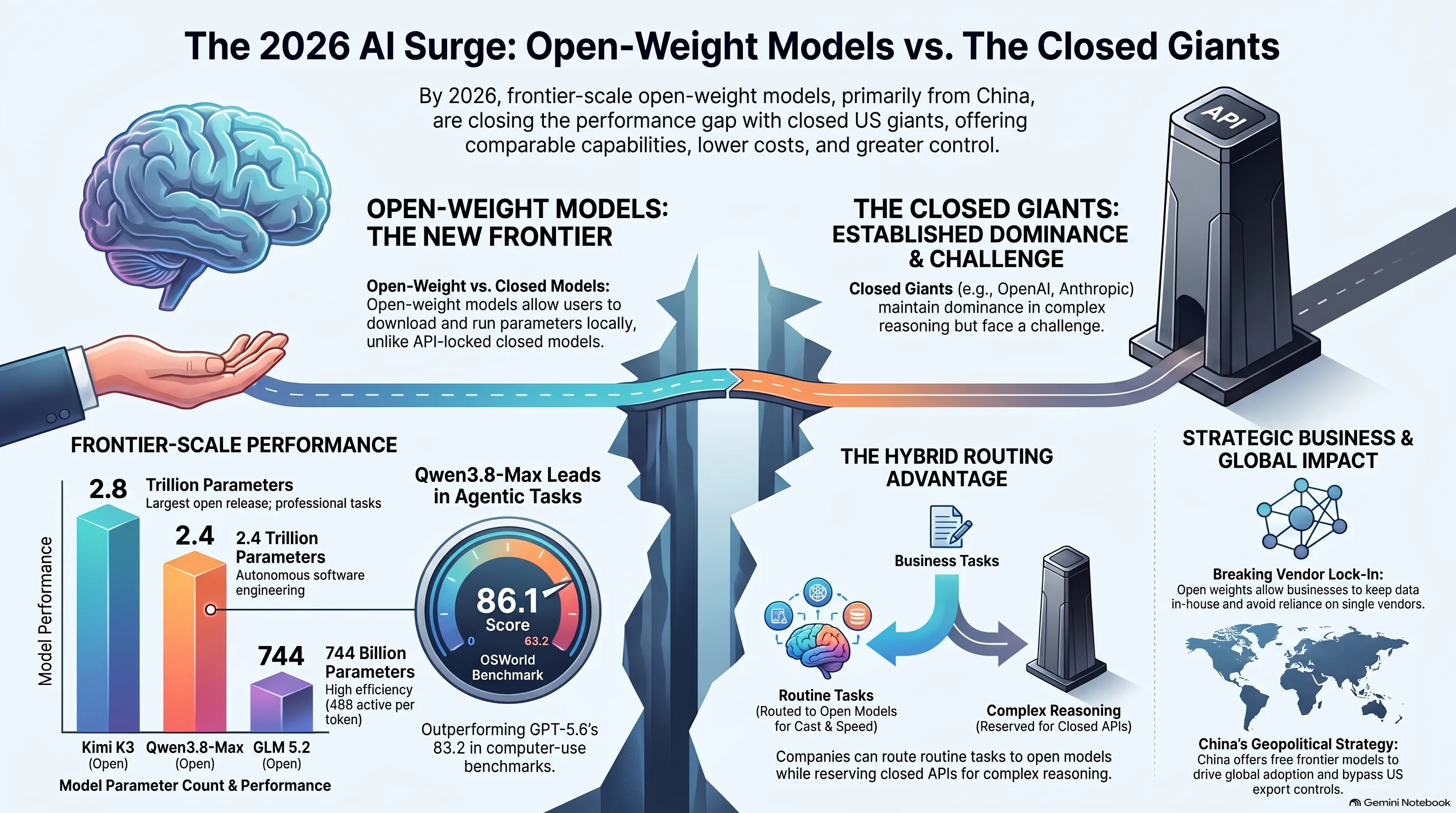
For most of the AI boom, the rule was simple: the best models were closed, controlled by a few American labs, and reachable only through an API. In 2026 that rule is breaking.
A wave of open-weight models—led by China's Kimi and Qwen—now rivals the closed giants on many tasks, and beats them on a few. These are not small research models; they are frontier-scale systems anyone can download and run.
This piece explains what open-weight really means, how close the gap has actually become, why China is giving its best models away, and what the surge means for businesses deciding where to place their bets.
🔓 What 'Open-Weight' Actually Means
The phrase gets used loosely, so start with a clear definition.
- Closed models (GPT, Claude, Gemini) — you reach them only through an API. The weights stay locked inside the lab.
- Open-weight models (Kimi, Qwen, Llama-style) — the trained parameters are published, so anyone can download, run, and fine-tune them.
- Fully open source — weights plus training code and data. This remains rare, even among 'open' models.
Most of 2026's headline releases are open-weight, not fully open source. You get the finished model to run yourself, but not always the recipe that made it. That distinction matters for trust, reproducibility, and safety. For practical use, though, open weights are enough to break dependence on a single vendor.
📈 The 2026 Surge: Trillion-Parameter Open Models
Open models used to be small and clearly behind. That is no longer true.
- Kimi K3 (Moonshot AI) — a ~2.8-trillion-parameter Mixture-of-Experts model, the largest open release yet, activating roughly 104 billion parameters per token
- Qwen3.8-Max (Alibaba) — a 2.4-trillion-parameter model aimed at autonomous software engineering, with open weights announced alongside a smaller Qwen3.8-27B
- GLM 5.2 (Zhipu) — 744 billion parameters, 40 billion active per token
These are frontier-scale systems released for anyone to download. According to weekly tracking from 404K Research, the season's leading open-weight models—Qwen3.8-Max, Kimi K3, and GLM 5.2—now compete directly with closed flagships on coding and agentic benchmarks.
📊 How Close Is the Gap, Really?
Close enough to matter—but with important caveats.
On some benchmarks, open models now lead. Alibaba reports Qwen3.8-Max scoring 86.1 on OSWorld-Verified, a test of AI agents operating a real computer, ahead of GPT-5.6 Sol Max (83.2) and Anthropic's Fable 5 (85.0). Kimi K3, per VentureBeat, placed third overall on a broad professional-tasks benchmark—behind only the very top US systems.
Two caveats keep the closed labs ahead for now:
- Vendor benchmarks flatter their own models. Launch-day numbers are rarely independently replicated, and gaps often appear under third-party testing.
- The hardest tasks still favor closed models. On messy, long-horizon reasoning and sustained multi-agent work, OpenAI and Anthropic's flagships remain the safest choice.
The honest summary: open models have caught up on many everyday and specialized tasks, and lead on a few, but the closed frontier still holds a slim edge on the toughest work.
🌏 Why China Is Giving Its Best Models Away
Releasing a model that cost hundreds of millions to train, for free, looks irrational—until you see the strategy.
- Adoption equals influence. A free, capable model gets embedded in products, tools, and government systems worldwide, spreading Chinese standards and reducing reliance on US labs.
- It answers the access problem. As US frontier models face export controls and gated launches, open Chinese models are simply easier for the rest of the world to obtain.
- It is a political message. At the 2026 World AI Conference, President Xi Jinping repeatedly championed 'openness' and open source, positioning China as the reliable, collaborative AI partner—especially for the Global South.
For middle powers weighing limited budgets, a capable model they can download, run locally, and control is a compelling offer. That is why open weights have become a geopolitical tool, not just an engineering choice.
🏢 What the Surge Means for Your Business
For companies actually deploying AI, the open-weight surge is mostly good news.
- Leverage on price. Even if you stay on closed APIs, cheap open competitors are dragging prices down across the board.
- Real optionality. You can route routine work to open models and reserve premium closed models for the hard cases.
- Control and residency. Open weights let regulated businesses keep data in-house and avoid vendor lock-in.
The frontier caveats still apply: 'open' does not mean 'easy' or 'free to run at scale,' and the biggest open models demand serious infrastructure. But the direction is clear—more capable models, more choice, lower cost for buyers. The winners will be teams that match each task to the right model instead of defaulting to the most expensive option.
Key Takeaways
Quick wins and actionable insights from this guide:
- Open-weight means a model's parameters are published to download and run—distinct from closed APIs and from fully open source
- 2026's open releases are frontier-scale: Kimi K3 (~2.8T), Qwen3.8-Max (2.4T), and GLM 5.2 (744B)
- Open models now lead on some benchmarks (Qwen3.8-Max beats GPT-5.6 and Fable 5 on OSWorld computer use) but trail slightly on the hardest reasoning
- Treat vendor launch benchmarks with skepticism until they are independently tested
- China gives models away to win global adoption, influence, and standards—especially across the Global South
- For businesses, the surge means lower prices, more optionality, and the ability to route tasks to the right model
Sources & Further Reading
This article is based on the following recent research, reporting, and primary sources:
- 1Qwen3.8-Max arrives claiming it outperforms GPT-5.6 Sol Max and Fable 5 on agentic computer use — VentureBeat
- 2China's Moonshot AI releases Kimi K3, the largest open-source model ever — VentureBeat
- 3Weekly AI Model Update: Open-Weight Models Close the Gap (Aug 2026) — 404K Research
- 4China Narrows U.S. AI Gap With Moonshot AI's Kimi K3, Alibaba's Qwen 3.8 — Foreign Policy
- 5China's Moonshot AI unveils Kimi K3 that rivals OpenAI, Anthropic — CNBC
AI 101 Services Team
AI Strategy & Research
AI 101 Services helps service businesses implement AI automation solutions that deliver measurable ROI. With 21+ solutions delivered and 15+ clients served, we specialize in turning manual chaos into streamlined digital workflows.