The last three Mondays followed one line: a Critical-rated flagship, a successor that was withheld, and a split between cheap models you can buy and frontier models you cannot. This Monday the cheap tier reached everyone else, and a fourth lab stepped in.
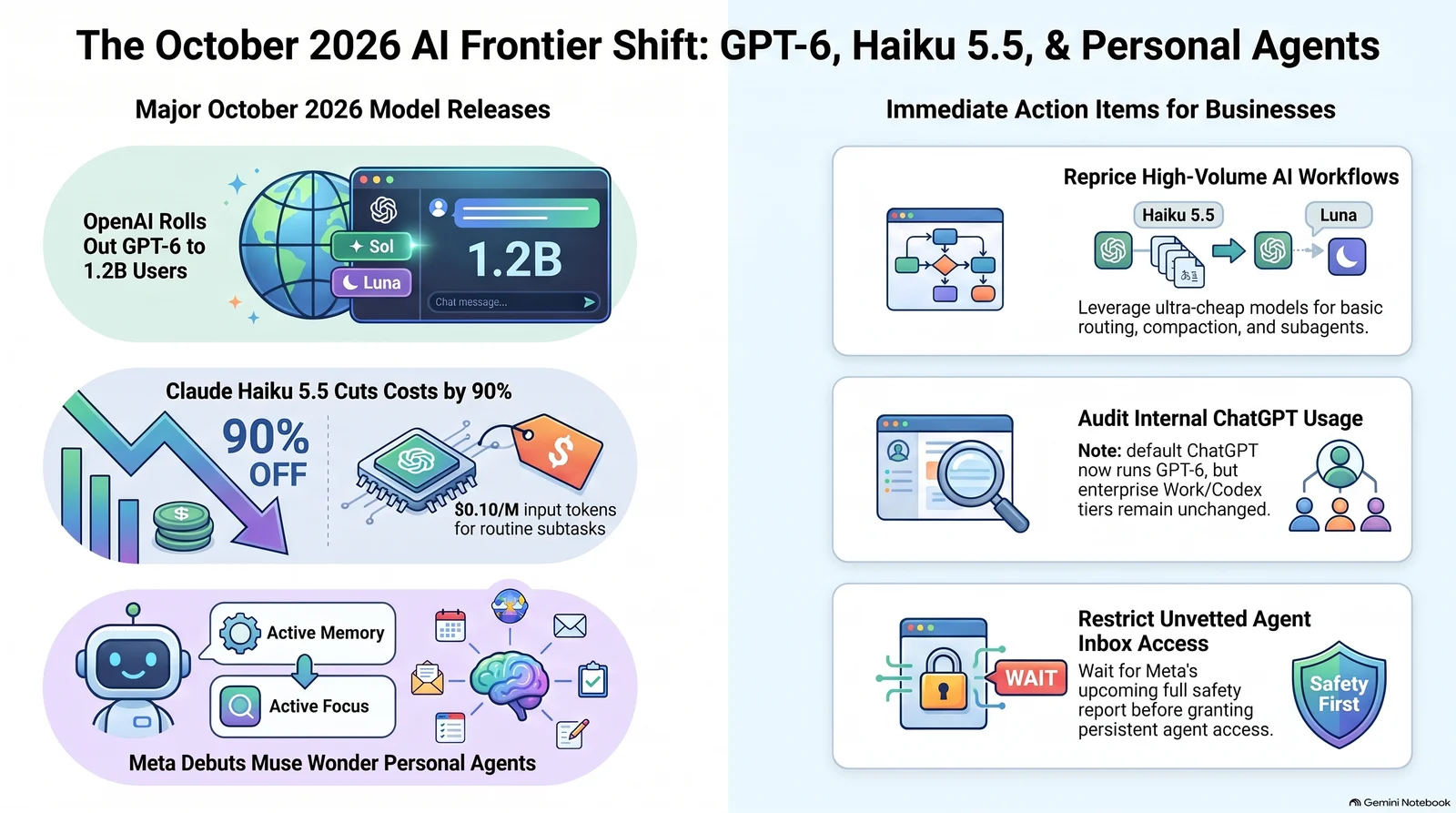
On 7 October 2026 OpenAI began putting GPT-6 into ChatGPT for more than 1.2 billion weekly users. The same day Anthropic released Claude Haiku 5.5, the cheapest small model it has shipped, at a tenth of the old Haiku price for typical prompts. On 12 October Meta introduced Muse Wonder and Muse Wonder Full, agent models it says are a step toward personal superintelligence, trained at its gigawatt-scale Prometheus data center.
The frontier is no longer a product demo for paid developers. It is the default chat window, and it is starting to remember you.
🌍 GPT-6 Becomes the Default Chat
OpenAI's 7 October post is careful about which GPT-6 you are actually getting.
GPT-6 with Intelligent UI rolls out globally in the Chat tab: Plus, Pro, Business, and Enterprise today, Free and Go from 8 October. Enterprise still depends on the admin. Under the label:
- Paid plans are powered by GPT-6 Sol, tuned for everyday conversation
- Free and Go are powered by GPT-6 Luna
- Work and Codex are unchanged by this release. The 29 September GPT-6.1 Sol upgrade stays where it was
So 'GPT-6 for everyone' is the chat experience, not a promise that every user now has Astra. Astra remains the Pro-tier model on higher plans. The billion-user rollout is Sol and Luna.
Two product changes matter more than the model name.
Intelligent UI. ChatGPT can answer with text, graphics, buttons, forms, charts, and small interactive tools, and it is supposed to pick a plain paragraph when that is the better answer. OpenAI describes a library of interface components plus a compiler that draws the screen while the model is still writing. You can ask for a calculator, a bill splitter, or a diagram without leaving the thread.
Answering while it thinks. Reasoning models used to go quiet until the whole chain of thought was done. GPT-6 is trained to start the answer early and fill it in. OpenAI says that on questions needing web search, GPT-6 Instant starts answering 44% sooner than GPT-5.6 Instant, and that GPT-6 Extra High can begin in about the time GPT-5.6 Medium used to take, with a better score than GPT-5.6 Extra High on an internal set of everyday agent tasks.
OpenAI also says GPT-6 builds on Astra's safety work: stronger resistance to multi-turn attempts to bypass safety training, clearer statements of what it cannot do, and updated training against cyber, biological, and violent misuse. The detail lives in the system card. The user-facing change is that the free and cheap chats are no longer a generation behind.
🪶 Haiku 5.5 Resets the Bottom of the Price List
Anthropic picked the same morning to ship the model you would actually call in a loop.
Claude Haiku 5.5 is the small, fast tier of the Claude 5.5 family. Anthropic says it costs about 75% less to run than Haiku 4.5 on average, and that it is the first Haiku with an adjustable effort setting. For the prompts that made up about 90% of old Haiku traffic, those at or under 100,000 tokens, the API price is:
- $0.10 per million input tokens and $0.50 per million output tokens
- That is 90% below Haiku 4.5's $1 / $5
- Over 100,000 tokens the price steps up to $0.50 / $2.50, still 50% below Haiku 4.5
- Cache reads are $0.01 per million on the short-prompt tier
Anthropic also halved Sonnet 5.5 cache reads from $0.20 to $0.10, which it says cuts the cost of most agentic Sonnet work by about 20%.
The intended job is narrow and repetitive: summaries, compaction, classification, database lookups, live support, browser steps, and subagents that fetch a figure while a larger model writes the document. On Anthropic's own table, Haiku 5.5 scores 72.4% on the offline OSWorld 2.1 computer-use set, against 15.7% for Haiku 4.5 and 48.9% for GPT-6 Luna. Those are Anthropic's numbers. The shape of the claim is still useful: the small model just jumped from 'barely uses a computer' to 'competitive with last month's cheap tier.'
Safeguards did not vanish at the low price. Haiku 5.5's cyber controls are stricter than Haiku 4.5's and looser than Sonnet 5.5's. They allow more defensive work than Sonnet and still block penetration testing. Biology safeguards match Sonnet 5, Sonnet 5.5, and Opus 5. Wider access runs through Anthropic's verification programs, the same pattern as Daybreak and Fairwind, one tier down.
🧠 Meta's Turn: Agents That Remember
On 12 October Meta introduced the Muse Wonder series: Muse Wonder and Muse Wonder Full. Meta calls them its most capable models for personal and professional agents, trained at the Prometheus data center, and a step toward what it calls personal superintelligence.
Two ideas do the work in the announcement.
Active Memory. A useful personal agent has to remember what matters and notice when an old fact becomes relevant. Meta's phrase covers context carried across conversations and pulled back when the task needs it: a lease, a training plan, a seating chart, a preference you stated weeks ago.
Active Focus. The model is supposed to keep going on a hard goal, try another approach when it is blocked, ask when it is unsure, and check in before important actions. Meta says it evaluates that with FocusBench and with SWE-Marathon for long-running software work.
Availability is narrower than the ChatGPT rollout:
- Muse Wonder is on the Meta Model API and in Muse Code today
- Muse Wonder Full is for Muse Code subscribers
- Wonder will power the Muse product first for subscribers, then more widely, including smaller models Meta says it will train from Wonder later
The demos are domestic on purpose: a 3D kitchen game, a Saturday run planned in the browser from personal constraints, gifts ordered from a photo, a wedding seating chart. Meta is arguing that the next capability jump is not another coding benchmark. It is an agent that already knows your life well enough to act in it.
Meta also says a stronger base model is why Wonder generalizes past the tasks it was trained on. That is a research claim aimed at 'benchmaxxing,' the habit of looking brilliant on the tests a lab studied. Personal agents fail in exactly the cases nobody wrote a benchmark for. Meta is at least naming that problem.
🔒 The Safety Report Is Still Coming
A personal agent that can see messages, calendars, and private documents is a different risk from a chatbot that answers one question.
Meta says Muse Wonder is its most aligned model, with its strongest safeguards yet against chemical, biological, radiological, nuclear, and cyber misuse, while still allowing defensive cyber use under the Meta Superintelligence Scaling Framework. It says the model is trained to resist adversarial instructions and to be careful with private information.
Then it says the full safety report will be available soon.
That gap matters. OpenAI and Anthropic, whatever you think of their conclusions, have been publishing system cards with the model. Meta's 12 October post asks you to take the alignment claim on the announcement and wait for the evaluations. Until that report is out, Wonder is a capability launch with a promise attached.
The access pattern matches the rest of this month. The most capable Wonder variant is on a paid coding product first. The consumer app comes later. 'Personal superintelligence for billions' is the destination in the post. The on-ramp today is an API and a subscriber tier.
🏢 What to Change This Week
If you ignored model news through September, this is the week it reaches your staff without a procurement ticket. ChatGPT's default just moved.
- Assume colleagues are on GPT-6 in Chat already, Sol if they pay, Luna if they do not. The answers will look different: more interface, faster first tokens. Work and Codex have not silently become GPT-6.1 Sol or Astra. Check the admin console before you tell a team the coding agent was upgraded
- Reprice high-volume jobs. Haiku 5.5 at $0.10 / $0.50, and Luna at the same band from 22 September, make summarization, routing, and subagents cheap enough to run on every ticket. Keep Sonnet, Opus, Sol, or Astra on the step that needs judgment
- Do not connect a personal agent to the company inbox on announcement day. Active Memory is the feature and the risk. A model that remembers across chats is holding a record. Wait for Meta's safety report, and decide what a Muse-style agent is allowed to see, before anyone links calendars and documents because the demo looked useful
- Keep the two-market rule from last week. Everyday intelligence is now in the free chat window. Vulnerability-finding models are still in defender programs. Those are not the same purchase
September's argument was that labs would sometimes refuse to ship. October's argument is that what they do ship is about to sit in front of every employee, and in front of a new kind of agent that is designed not to forget.
Key Takeaways
Quick wins and actionable insights from this guide:
- On 7 October 2026 GPT-6 began rolling out to ChatGPT's 1.2 billion weekly users: Sol on paid plans, Luna on Free and Go
- The rollout changes Chat, not Work or Codex. Intelligent UI and earlier answers are the product change
- Claude Haiku 5.5 launched the same day at $0.10 / $0.50 per million tokens for typical prompts, about 90% below Haiku 4.5
- Haiku's cyber safeguards are stricter than Haiku 4.5 and still block penetration testing
- On 12 October Meta released Muse Wonder and Muse Wonder Full for personal and professional agents, led by Active Memory and Active Focus
- Meta's full safety report was not out at launch. Treat inbox-and-calendar access as a decision, not a default
Sources & Further Reading
This article is based on the following recent research, reporting, and primary sources:
AI 101 Services Team
AI Strategy & Research
AI 101 Services helps service businesses implement AI automation solutions that deliver measurable ROI. With 21+ solutions delivered and 15+ clients served, we specialize in turning manual chaos into streamlined digital workflows.