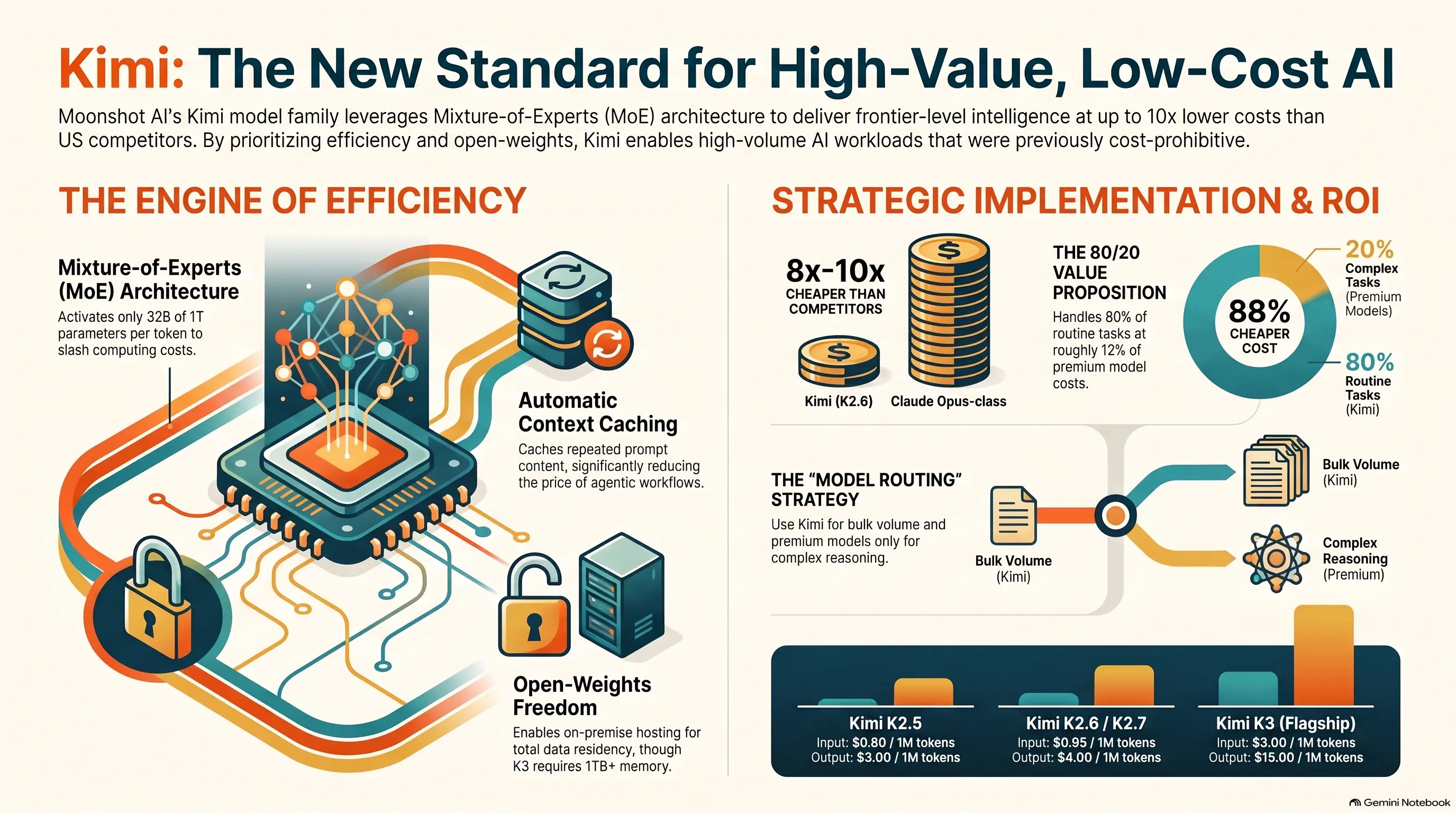
In 2025, DeepSeek stunned the world by matching top American models at a fraction of the cost. In 2026, the standard-bearer for cheap, capable AI is Kimi—the model family from Beijing-based Moonshot AI.
Kimi is not cheap because it is weak. It approaches the top of the market on several benchmarks while costing a fraction of what Claude or GPT charge. That combination is forcing every business and every government to rethink what a frontier model should cost.
So how did Moonshot pull this off? The answer is a mix of clever architecture, an open-weights strategy, and aggressive pricing. This deep dive explains why Kimi is so efficient, exactly how cheap it is, where the savings break down, and when it is—and is not—the right choice for your business.
📉 From Underdog to Open-Source Comeback
Moonshot AI was not always the story. Founded in 2023, it once ranked third in monthly active users in China—until DeepSeek's low-cost R1 model landed in January 2025 and knocked Kimi down to seventh.
The Strategic Pivot: Rather than compete on closed, premium models, Moonshot went the other way—open weights and radical cost efficiency.
- Kimi K2 (July 2025) — a 1-trillion-parameter open model
- Kimi K2.5 (January 2026) — accelerated the open-source push
- Kimi K2.6 / K2.7 Code (April 2026) — cheap, agentic, coding-focused
- Kimi K3 (July 2026) — a ~2.8-trillion-parameter flagship, the largest open model ever released
The Payoff: Moonshot raised $2 billion at a valuation above $20 billion in mid-2026. Per CNBC, Kimi K3 trails only the very best US systems on overall performance while beating many strong models on coding and agentic tasks.
The comeback worked because it targeted the industry's real anxiety in 2026: not "is the model smart enough?" but "can we afford to run it at scale?"
🧠 The Secret Sauce: Mixture-of-Experts
Kimi's efficiency starts with its architecture: a Mixture-of-Experts (MoE) design.
How MoE Works (Plain English): A traditional "dense" model activates every one of its parameters for every single word it processes. That is enormously expensive.
An MoE model is split into many specialized sub-networks called "experts." For each token, a router activates only a small fraction of them.
The Numbers That Matter:
- Kimi K2.6 has 1 trillion total parameters—but activates only about 32 billion per token (roughly 384 experts, with 8 selected plus 1 shared)
- This means you get the knowledge of a giant model at the running cost of a much smaller one
Other Efficiency Tricks:
- Automatic context caching — repeated prompt content is cached with no extra parameters to manage, cutting the cost of agentic workloads that resend big system prompts
- Multi-head Latent Attention (MLA) — reduces memory overhead on long contexts
- Native multimodality — a compact vision encoder handles images and video
The Result? MoE is the single biggest reason Kimi can be both large and cheap. It is the same idea behind other 2026 heavyweights like Qwen3.8-Max—but Moonshot pushed the price advantage hardest.
💰 The Price Shock: Kimi vs Claude vs GPT
Efficiency only matters if it shows up on the invoice. With Kimi, it does—dramatically.
Kimi API Pricing (per million tokens, mid-2026):
- Kimi K2.5 — about $0.60 input / $3.00 output
- Kimi K2.6 and K2.7 Code — about $0.95 input / $4.00 output
- Kimi K3 (flagship) — about $3.00 input / $15.00 output, with cache hits as low as $0.30
The Comparison That Stings: According to independent write-ups, Kimi K2.6 is roughly 8x cheaper on input and 10x cheaper on output than Claude Opus-class models. For high-volume, output-heavy work like code generation, that gap compounds fast.
Even Cheaper via Third-Party Hosts: Because the weights are open, providers compete to serve them. Benchmarks across nine hosts put blended costs as low as $1.15 per million tokens (Parasail) or $1.44 with cached pricing (DeepInfra)—well below any premium closed model.
The Practical Impact: One independent review found that for about 80% of standard coding tasks, K2.6 delivered 80-90% of Claude's quality at roughly 12% of the cost. For output-heavy pipelines, that is the difference between a feature being affordable and being shelved.
📖 Open Weights: Freedom With a Catch
Kimi's weights are published, which sounds like "free AI." The reality is more nuanced.
The Genuine Upside:
- You can self-host with no per-token API fees
- You can fine-tune the model on your own data
- Your data never leaves your infrastructure—a real win for regulated industries and sovereignty-minded governments
- Kimi's API is OpenAI-SDK compatible, so switching costs are low
The Catch Nobody Mentions: "Open weights" does not mean "cheap to run." A 2.8-trillion-parameter model like K3 requires more than 1TB of memory just to load, and needs a datacenter-grade cluster—often 8 to 64 accelerators—to serve.
What This Means in Practice:
- For most businesses, the hosted API is still the cheapest, simplest path
- Self-hosting only pays off at very high volume, or when data residency legally requires it
- Hardware, operations, power, and serving stacks are real costs that "zero API spend" hides
Warning Sign: If a vendor pitches self-hosting an open model as "free AI," ask them who pays for the GPU cluster, the ops team, and the electricity. That is where the true cost lives.
🧪 The Benchmark Reality Check
Kimi's launch numbers are impressive—but launch numbers always deserve scrutiny.
What Moonshot Claims: On vendor-published tables, K2.6 posts strong results—leading several models on SWE-Bench Pro, agentic search, and tool use. K3, per VentureBeat, placed third overall on a real-world professional-tasks benchmark, behind only the top US flagships.
What Independent Testing Shows: The picture gets more honest when third parties test the models:
- On SWE-Bench Verified, K2.6 scored 80.2%—strong, but behind Claude Opus 4.7's 87.6%
- On one real workflow-orchestration spec, an independent evaluator scored Claude Opus 4.7 at 91/100 versus K2.6 at 68/100
- The gaps concentrate in ambiguous specs, deep multi-file reasoning, and sustained multi-agent coordination—exactly what benchmark suites miss
The Balanced Takeaway: Kimi is genuinely frontier-adjacent and unbeatable on price-performance for routine work. But for the hardest 20% of tasks—messy, long-horizon, high-stakes reasoning—the best US models still win independent comparisons.
The Result? Treat launch benchmarks as a starting point, not gospel. Run any model against your actual workload before you commit.
🧭 When Kimi Is the Right Call
So should you use Kimi? It depends entirely on the job.
Kimi Is a Strong Choice For:
- High-volume, output-heavy work (bulk code generation, refactoring, data extraction)
- Cost-sensitive products where per-token price decides whether a feature ships
- Agentic workflows that resend large contexts (context caching shines here)
- Organizations needing data residency or on-prem control via open weights
Stick With Premium US Models For:
- The hardest reasoning, ambiguous specs, and mission-critical accuracy
- Sustained multi-agent coordination where small errors compound
- Cases where the cost of a wrong answer dwarfs the cost of tokens
The Smart Pattern—Model Routing: The best-run teams in 2026 do not pick one model. They route: cheap, capable models like Kimi handle the bulk of the volume, and expensive frontier models handle the small slice of hard cases. This is exactly the ROI discipline we bring to automation projects—use the right tool for each task, not the most expensive tool for every task.
How to Decide:
- Week 1: Run Kimi against a real slice of your workload alongside your current model
- Week 2: Compare quality, latency, and cost on your actual tasks—not leaderboards
- Then decide: migrate fully, route by task type, or stay put
The Result? For most businesses, Kimi will not replace your best model everywhere—but it will quietly slash the cost of the 80% of work that never needed a premium model in the first place.
Key Takeaways
Quick wins and actionable insights from this guide:
- Kimi (Moonshot AI) is 2026's benchmark for cheap, capable AI—approaching frontier performance at a fraction of the cost
- Its efficiency comes from a Mixture-of-Experts design that activates only ~32B of 1T parameters per token, plus automatic context caching
- Kimi K2.6 runs roughly 8-10x cheaper than Claude Opus-class models; third-party hosts push blended costs near $1.15-1.44 per million tokens
- Open weights enable self-hosting and data residency, but a 2.8T model like K3 needs 1TB+ of memory and a GPU cluster—open does not mean free
- Independent tests show Kimi trails top US models on the hardest 20% of reasoning and multi-agent tasks, despite strong launch benchmarks
- The winning strategy is model routing: use Kimi for high-volume routine work and premium models only for the hardest cases
Sources & Further Reading
This article is based on the following recent research, reporting, and primary sources:
- 1China's Moonshot AI unveils Kimi K3 that rivals OpenAI, Anthropic — CNBC
- 2China's Moonshot AI releases Kimi K3, the largest open-source model ever — VentureBeat
- 3Kimi K2: Open Agentic Intelligence (technical overview) — Moonshot AI
- 4Kimi API Pricing (August 2026): Kimi K3 at $3/$15 — BenchLM.ai
- 5Kimi K2.6 API Benchmarks: Latency, TPS & Cost Analysis (2026) — DeepInfra
- 6China Narrows U.S. AI Gap With Moonshot AI's Kimi K3, Alibaba's Qwen 3.8 — Foreign Policy
AI 101 Services Team
AI Strategy & Research
AI 101 Services helps service businesses implement AI automation solutions that deliver measurable ROI. With 21+ solutions delivered and 15+ clients served, we specialize in turning manual chaos into streamlined digital workflows.