When a lab publishes a frontier model's weights, the pitch sounds unbeatable: download it once, run it forever, pay no per-token fees. No vendor, no usage bill, no lock-in.
It is a real advantage—but 'free to download' and 'free to run' are very different things. The download is the cheapest part of the whole exercise. Everything after it costs money, and at frontier scale, it costs a lot.
This article breaks down what self-hosting a large open model actually requires, so you can decide when it is worth it and when a hosted API is the smarter, cheaper choice.
🧱 The Memory Wall
The first shock is memory. A model's weights have to fit into GPU memory to run.
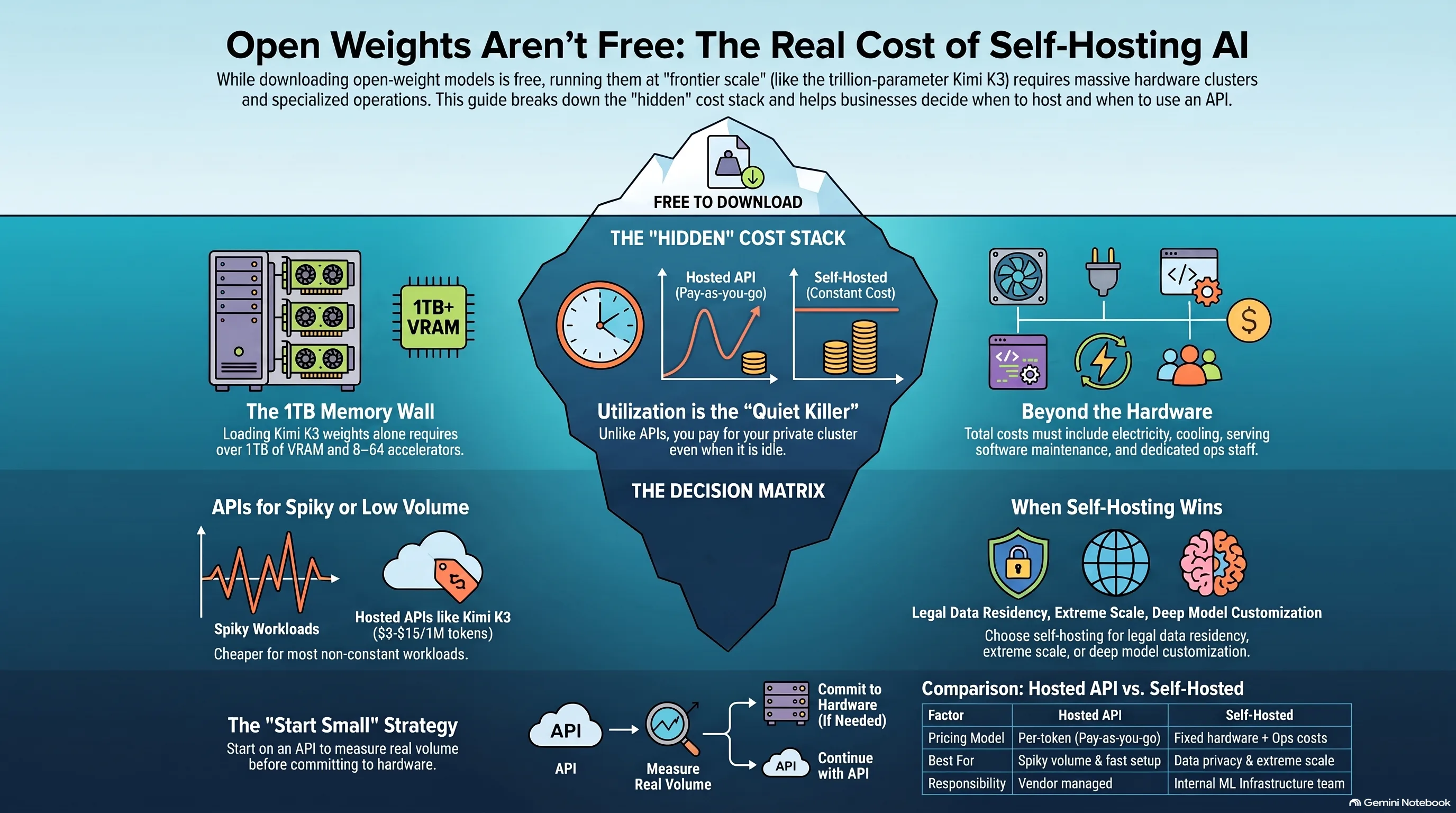
A trillion-plus-parameter model is enormous. Loading Kimi K3's weights alone requires more than 1TB of memory—before you account for anything else. Two factors drive this:
- Parameter count and precision. Each parameter takes one to two bytes depending on quantization. Billions of parameters add up to hundreds of gigabytes or more.
- The KV cache. Long context windows (K3 supports up to 1 million tokens) need extra memory that grows with every token in the conversation.
No single GPU has 1TB of memory. So you need a cluster—often 8 to 64 accelerators wired together—just to hold the model. This is the wall that turns 'free weights' into a serious hardware project.
💵 The Real Cost Stack
Memory is only the beginning. Self-hosting a frontier model carries a full stack of costs:
- GPUs — datacenter accelerators cost tens of thousands of dollars each, or several dollars per hour to rent, and the cluster runs continuously.
- Power and cooling — large clusters draw serious electricity around the clock.
- Serving software — you need an inference stack (batching, routing, quantization) tuned and maintained.
- Ops and reliability — someone has to keep it running, patched, and monitored.
- Utilization risk — you pay for the cluster whether it is 100% busy or 10% busy.
That last point is the quiet killer. APIs are cheap partly because the provider spreads a giant cluster across thousands of customers. Your private cluster serves only you—so unless you keep it heavily loaded, your effective cost per token can dwarf the API price.
⚖️ API vs Self-Host: The Break-Even Math
Hosted APIs are aggressively cheap in 2026. Kimi K3 runs around $3 input and $15 output per million tokens; smaller Kimi tiers cost far less, and third-party hosts push blended costs near $1.15-1.44 per million tokens.
To beat that with your own hardware, you need enough steady volume to keep an expensive cluster busy month after month. The rough logic:
- Low or spiky volume — the API wins easily. You pay only for what you use.
- High, steady volume — self-hosting can win, if utilization stays high and you have the ops capability.
- Everything in between — the API usually still wins once you count staff time and idle capacity.
Most teams dramatically underestimate the volume needed to break even, and overestimate how consistently their traffic will keep a cluster full.
✅ When Self-Hosting Actually Wins
Self-hosting is not a mistake—it is the right call in specific situations:
- Data residency and privacy — regulated industries or governments that legally cannot send data to a third-party API
- Extreme, predictable scale — very high, steady token volume that keeps a cluster near full utilization
- Deep customization — heavy fine-tuning of the weights for a proprietary domain
- Latency or offline needs — environments that cannot depend on an external API
Outside these cases, the hosted API is almost always cheaper and simpler. Open weights still deliver value here as leverage and as an exit option—you are never trapped with one vendor, even if you never self-host.
🧭 How to Decide
Before committing to self-hosting, answer these honestly:
- What is our real monthly token volume, and how steady is it?
- Do we have—or can we hire—an ML infrastructure team?
- Are there legal reasons the data cannot leave our environment?
- What is the fully loaded cost (GPUs, power, ops, idle time), not just the sticker price of a GPU?
- Have we compared that number to the actual API cost for the same workload?
If you cannot confidently answer all five, start on a hosted API, measure real usage for a month or two, and revisit. The weights are not going anywhere—and you will make a far better decision with real numbers than with the fantasy of 'free.'
Key Takeaways
Quick wins and actionable insights from this guide:
- Open weights are free to download but not free to run—the download is the cheapest part
- Frontier models hit a memory wall: Kimi K3 needs 1TB+ of memory and a cluster of 8-64 accelerators just to load
- The true cost stack includes GPUs, power, serving software, ops, and the risk of paying for idle capacity
- Hosted APIs are cheap because providers share clusters across many customers; a private cluster only pays off at high, steady utilization
- Self-hosting wins for data residency, extreme predictable scale, deep customization, or offline and latency needs
- Start on an API, measure real volume, and only move to self-hosting with actual numbers in hand
Sources & Further Reading
This article is based on the following recent research, reporting, and primary sources:
- 1Weekly AI Model Update: 'Available Weights' Do Not Mean Low-Cost Deployment (Aug 2026) — 404K Research
- 2Kimi K2.6 API Benchmarks: Latency, TPS & Cost Analysis (2026) — DeepInfra
- 3Kimi API Pricing (August 2026): Kimi K3 at $3/$15 — BenchLM.ai
- 4China's Moonshot AI releases Kimi K3, the largest open-source model ever — VentureBeat
AI 101 Services Team
AI Strategy & Research
AI 101 Services helps service businesses implement AI automation solutions that deliver measurable ROI. With 21+ solutions delivered and 15+ clients served, we specialize in turning manual chaos into streamlined digital workflows.