When people picture AI today, they often think of chatbots or photo tools. That is only the surface. Large language models (LLMs) have quietly become national infrastructure—as strategic as power grids, chip fabs, and telecom networks.
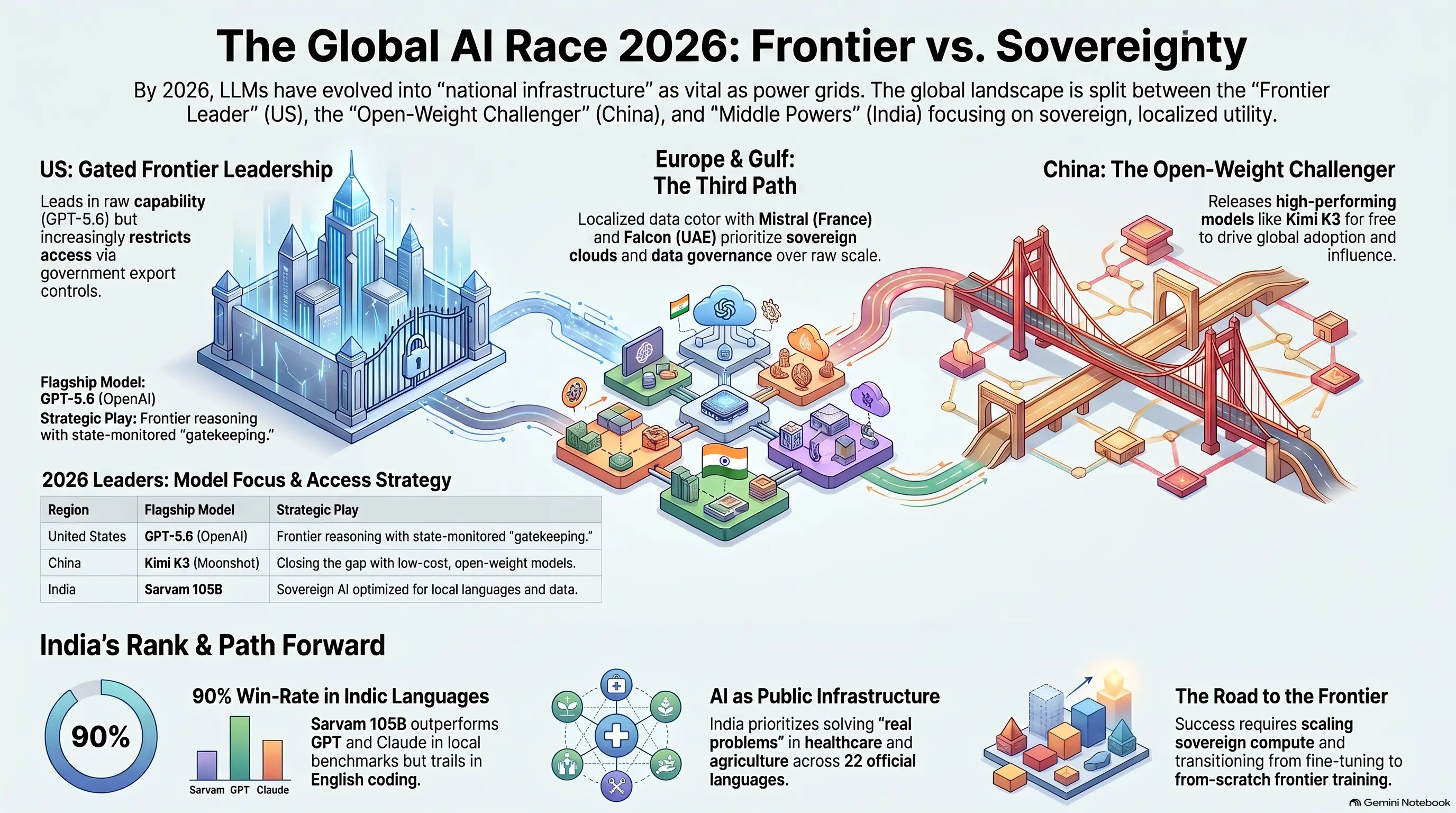
In 2026, the world has effectively split into AI powers. The United States and China build the frontier. Europe and the Gulf build sovereign alternatives. And a group of ambitious nations—India among them—are building models that understand their own languages, laws, and problems.
So where does each country actually stand, where does India rank, and what would it take for India to reach the frontier? This guide maps the global LLM race using recent research and primary sources—and shows why LLMs are really about solving deep national problems.
🗺️ The World Just Split Into AI Powers
"AI sovereignty" is the phrase of the year—but it does not mean what most people think.
According to analyses from Stanford's Institute for Human-Centered AI (FSI) and the Brookings Institution, sovereignty is not about total self-sufficiency ("autarky"), which is structurally impossible. The AI stack—minerals, energy, chips, data, models, talent—is global, with a handful of choke points no single country controls.
Instead, sovereignty is better understood as agency: a nation's ability to make independent choices about how AI is built, governed, and deployed in line with its own interests.
The Practical Map of 2026:
- The United States and China own the frontier (the most capable models)
- Europe and the Gulf pursue open-weight sovereign alternatives
- Middle powers (India, and much of the Global South) build cheaper, multilingual, locally-attuned models—or fine-tune open ones
Why It Matters: Whoever controls the models increasingly influences the economy, security, and even the language and culture embedded in everyday software. That is why over two dozen countries have signed onto competing AI cooperation efforts, and why India put AI sovereignty at the center of the February 2026 AI Impact Summit it hosted.
🇺🇸 The United States: The Frontier Leader
The US still sits at the top of the capability ladder in 2026, led by a small cluster of frontier labs.
The Key Players:
- OpenAI — the GPT-5.6 family (Luna, Terra, Sol), released July 2026
- Anthropic — Claude (Fable 5, Mythos 5), strong on coding and safety
- Google DeepMind — Gemini 3.1 (Pro and Flash tiers)
What Sets the US Apart:
- The deepest pool of compute, capital, and top-tier research talent
- The most capable models on hard reasoning, coding, and science benchmarks
- A dense commercial ecosystem turning models into products fast
The New Twist—Government Gatekeeping: US leadership now comes with state oversight. Under Executive Order 14409 (June 2026), frontier labs submit their most capable models for a classified pre-release review before broad launch. OpenAI's GPT-5.6 shipped in a limited preview at the government's request, and Anthropic's Fable and Mythos models were briefly pulled from foreign access under export controls.
The net effect: the US leads on raw capability, but its frontier models are increasingly gated—pushing other countries toward open alternatives they can access and control.
🇨🇳 China: The Open-Weight Challenger
China's strategy is the mirror image of America's: instead of gating the frontier, it is giving models away.
The Key Players:
- Moonshot AI — Kimi (K3, a ~2.8-trillion-parameter open model released July 2026)
- Alibaba — Qwen (Qwen3.8-Max, a 2.4-trillion-parameter model claiming top-tier agentic performance)
- DeepSeek — the low-cost R1 model that shocked the market in early 2025
- Zhipu — the GLM family
The Playbook—Cheap and Open: Chinese labs release open-weight models that are dramatically cheaper to use than the best American systems while closing the capability gap. Per CNBC and Foreign Policy reporting, Kimi K3 trails only the very top US models on overall performance—and beats many of them on specific coding and agent benchmarks.
Why This Is Strategic: At China's 2026 World AI Conference, President Xi Jinping repeatedly championed "openness" and open source. The pitch is aimed squarely at middle powers deciding where to spend limited budgets. When a capable model is free to download and cheap to run, adoption follows—and with it, influence over global standards.
The trade-off for adopters: relying entirely on foreign models—open or closed—means someone else can change the terms, the price, or the access overnight.
🇪🇺 Europe & the Gulf: The Sovereign Alternative
Unable to match US or Chinese scale head-on, other powers are carving out a "third path" built on open weights and sovereign infrastructure.
France — Mistral: France is Europe's clearest contender. Mistral ships competitive open-weight models, and the state has anchored the full stack: the Jean Zay supercomputer, a planned ~1.4 GW MGX/Bpifrance/Mistral/NVIDIA AI campus near Paris, sovereign-cloud initiatives (Bleu, SecNumCloud), and strong GDPR enforcement. That coherence—models plus compute plus data governance—is what gives France real leverage.
The UAE — Falcon: The Gulf has invested heavily in open models like Falcon, positioning itself as a well-funded, neutral supplier of sovereign AI to the Global South.
The "Third Stack" Idea: Stanford FSI describes a potential alternative to the US and Chinese ecosystems—built by a coalition of middle powers pooling purchasing power around open models and diverse hardware. The catch: it only works if those countries coordinate on standards, which is a hard collective-action problem.
The Common Thread: Open weights let a country customize a model for its own languages, laws, and domains while keeping data and control at home. That is exactly the logic driving India.
🇮🇳 Where India Actually Ranks (The Honest Answer)
India is a serious player—but honesty matters more than cheerleading here.
The Foundation—IndiaAI Mission: Approved in March 2024 with an outlay of about ₹10,371 crore, the IndiaAI Mission received 506 proposals for indigenous foundation models and selected 20 for support (12 large models and 8 small language models). It has sanctioned over 93 lakh GPU hours and pooled tens of thousands of GPUs into a shared compute facility.
The Flagship—Sarvam AI: Bengaluru-based Sarvam, valued above $1.5B by mid-2026, open-sourced two models in February 2026 trained entirely on IndiaAI Mission compute:
- Sarvam 30B — a fast ~32B-parameter Mixture-of-Experts model
- Sarvam 105B — a ~106B-parameter model for complex reasoning
Others in the race: BharatGen (an IIT Bombay-led consortium behind Param2-17B), Krutrim, Tech Mahindra's Project Indus, and Gnani.AI's speech models.
Where India Leads: On Indian-language benchmarks like IndicBench, Sarvam 105B wins roughly 90% of comparisons against GPT, Claude, and Gemini—a structural advantage from training deeply on Indic data no Western lab has matched.
Where India Trails: On English-centric global benchmarks, the picture reverses. On the Artificial Analysis Intelligence Index, Sarvam 105B scores around 18—behind even mid-tier open models like Mistral Small 4, and far behind frontier GPT and Claude systems. On autonomous coding (TerminalBench Hard), India's models score in the low single digits versus 20%+ for stronger open models.
The Honest Ranking: India is a clear leader in sovereign, multilingual AI and firmly in the global top tier of nations building their own models—but it is roughly a generation behind the US and China on frontier reasoning and agentic capability.
🏎️ We're Driving a Ferrari to the Grocery Store
Most people use LLMs for a fraction of what they can do—like buying a Ferrari and only ever driving it to pick up groceries. The engine is built for far more.
For a country like India, that gap is the opportunity. LLMs are not a novelty for drafting emails; they are a way to solve problems that have resisted solutions for decades.
Real Problems LLMs Can Attack:
- Healthcare access — A model that speaks 22 languages can triage symptoms, explain prescriptions, and support rural health workers where doctors are scarce
- Agriculture — Advisory agents can answer a farmer's question about pests, weather, or crop prices in their own dialect, over a basic phone
- Justice and citizen services — LLMs can translate legal documents, help citizens navigate government schemes, and clear paperwork backlogs
- Education — A tutor that teaches in a child's mother tongue, not just English, reaches hundreds of millions currently left behind
This is why language depth matters more than leaderboard rank. A model that tops an English coding benchmark is useless to a farmer in Odisha; a model that understands Odia, however imperfect globally, can change that farmer's day. Applied at national scale in local languages, an LLM becomes public infrastructure—not a gadget.
🚀 What India Needs to Do to Reach the Frontier
India has momentum and a genuine language moat. Closing the frontier gap needs sustained work on four fronts.
1. Compute at Scale Frontier training needs tens of thousands of top GPUs for months. India's shared compute facility and semiconductor missions (₹1.64 lakh crore of approved fab investment) are the right start—but sovereign compute must keep expanding, and fast.
2. Indic Data Depth India's advantage is data no one else has: 22 official languages and hundreds of dialects. Building large, clean, rights-cleared Indic datasets—text, speech, and multimodal—is the single highest-leverage investment.
3. From Fine-Tuning to From-Scratch Frontier Many sovereign efforts adapt open Western or Chinese bases. Sarvam's from-scratch training proves India can go further. The next leap is training frontier-class models—not just efficient regional ones.
4. Talent and Patient Capital Frontier labs run on elite researchers and multi-year funding that tolerates failure. India must retain returning talent, fund long-horizon research, and let winners scale.
The Realistic Path: India will not out-spend the US or out-open China overnight. But it can own the sovereign-multilingual frontier decisively, use open models pragmatically where it makes sense, and build frontier capability deliberately over the next few years.
The bottom line: a country that treats LLMs as infrastructure for health, agriculture, justice, and education wins the race that actually matters for its citizens.
Key Takeaways
Quick wins and actionable insights from this guide:
- AI sovereignty in 2026 means agency—independent control over how AI is built and used—not total self-sufficiency
- The US leads on frontier capability (OpenAI, Anthropic, Google) but increasingly gates its models via government review
- China competes with cheap, open-weight models (Kimi, Qwen, DeepSeek) to win global adoption and influence
- India leads on sovereign, multilingual AI (Sarvam wins ~90% of Indian-language benchmarks) but trails a generation behind on frontier English reasoning and coding
- LLMs matter for India because they can solve healthcare, agriculture, justice, and education problems in local languages—not just edit photos
- To reach the frontier, India needs more sovereign compute, deep Indic datasets, from-scratch frontier training, and patient capital for talent
Sources & Further Reading
This article is based on the following recent research, reporting, and primary sources:
- 1AI Sovereignty, Diffusion, and Risk: Strategy in a Contested Landscape — Stanford FSI
- 2Is AI sovereignty possible? Balancing autonomy and interdependence — Brookings Institution
- 3Sovereignty in the Age of AI: Strategic Choices, Structural Dependencies — Tony Blair Institute
- 4China Narrows U.S. AI Gap With Moonshot AI's Kimi K3, Alibaba's Qwen 3.8 — Foreign Policy
- 5India backs 20 homegrown AI foundation models, clears ₹1.64 lakh crore semiconductor projects — Fortune India
- 6India Sovereign AI Status 2026: IndiaAI Mission, Sarvam Models, Gaps & Geopolitics — explainX
- 7Sarvam AI unveils indigenously-built 30B and 105B LLM models — The Hindu BusinessLine
- 8The LLM Landscape: A Developer's Guide to Model Families — ml4devs
AI 101 Services Team
AI Strategy & Research
AI 101 Services helps service businesses implement AI automation solutions that deliver measurable ROI. With 21+ solutions delivered and 15+ clients served, we specialize in turning manual chaos into streamlined digital workflows.