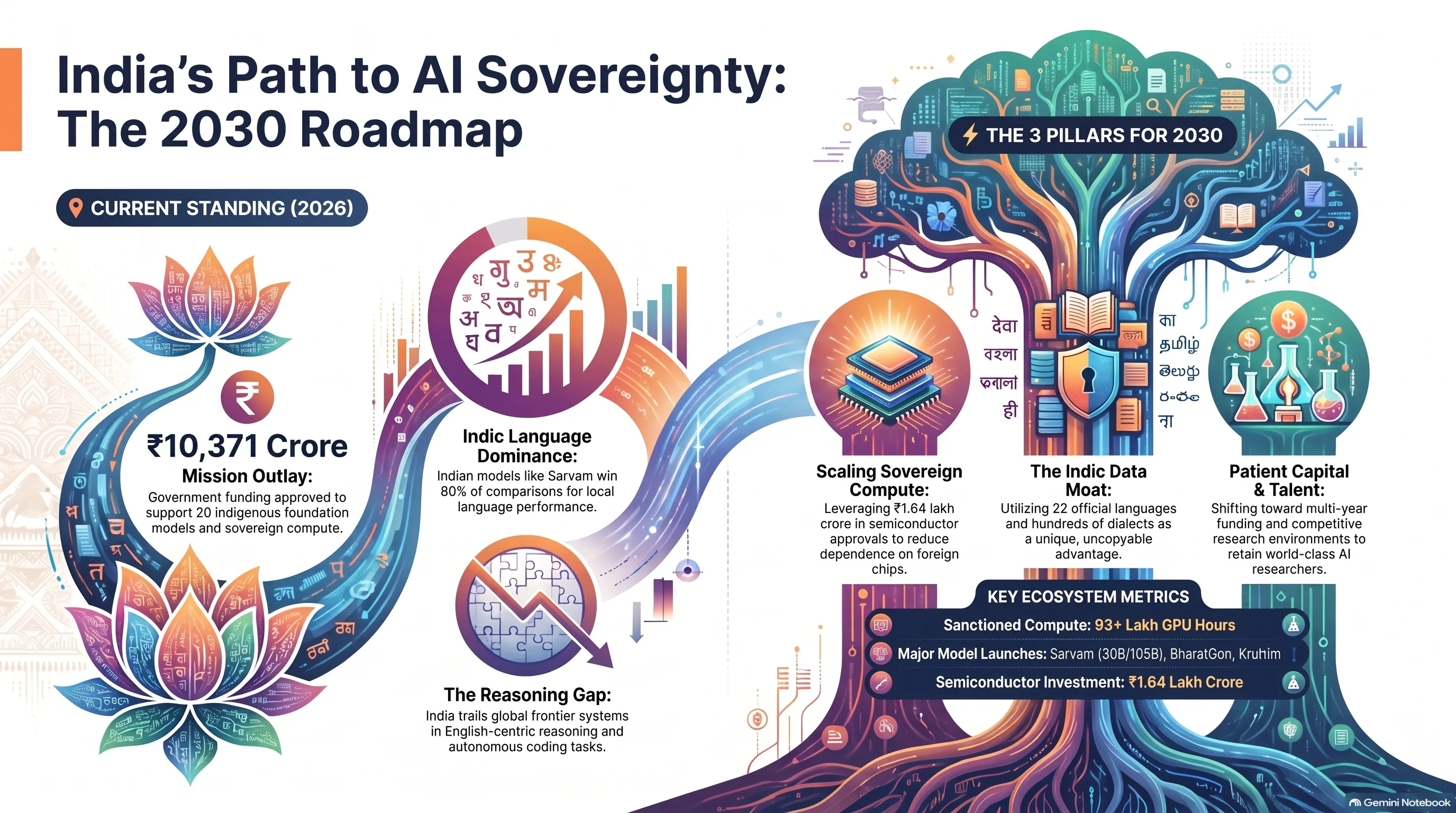
India enters the AI race with a genuine position, not a token one. It leads the world on Indian-language performance—but trails the US and China by roughly a generation on frontier reasoning and autonomous coding.
Closing that gap is not about a single breakthrough. It is about sustaining four things—compute, data, from-scratch training, and talent with patient capital—for years, through political and market cycles.
This roadmap lays out what India has already built, where the real gaps are, and a realistic definition of winning by 2030.
📍 Where India Stands in 2026
The foundation is real. Under the IndiaAI Mission—approved in March 2024 with an outlay of about ₹10,371 crore—the government selected 20 indigenous foundation models for support, sanctioned over 93 lakh GPU hours, and pooled tens of thousands of GPUs into shared compute.
The flagship results are concrete: Sarvam AI open-sourced 30B and 105B models trained entirely on mission compute, while BharatGen (IIT Bombay-led), Krutrim, and Tech Mahindra's Project Indus are all in the field.
The honest scorecard: India leads globally on Indian-language benchmarks—Sarvam wins roughly 90% of comparisons there—but sits well behind frontier GPT and Claude systems on English-centric reasoning and coding. The rest of this roadmap is about the four pillars that close that gap.
⚡ Pillar 1: Compute at Scale
Frontier training is brutally compute-hungry—tens of thousands of top-tier GPUs running for months. This is India's hardest constraint.
Progress is genuine: the shared compute facility, 93+ lakh sanctioned GPU hours, and semiconductor manufacturing approvals worth ₹1.64 lakh crore all point the right way. But two gaps remain:
- Scale. Frontier labs abroad command far larger dedicated clusters. India's pooled model is efficient but smaller.
- Domestic supply. Most advanced chips are still imported. The semiconductor missions aim to change that, but fabs take years to mature.
The priority is sustained expansion of sovereign compute—so Indian labs can train frontier-scale models at home without waiting in line for foreign capacity.
🗣️ Pillar 2: Indic Data Depth (The Real Moat)
If compute is India's weakness, data is its superpower.
No other country has India's linguistic wealth: 22 official languages and hundreds of dialects, spoken by over a billion people. Western frontier models train overwhelmingly on English and cannot match this depth—which is exactly why Sarvam wins the overwhelming majority of Indian-language comparisons.
To turn that into a durable advantage, India should invest in:
- Large, clean, rights-cleared datasets across text, speech, and images in every major language
- Dialect and low-resource language coverage, not just the top few
- Domain data for health, agriculture, law, and education, where the highest-impact use cases live
This is the highest-leverage investment India can make. Compute can be rented; this data moat cannot be copied.
🛠️ Pillar 3: From Fine-Tuning to Frontier Training
Many sovereign efforts worldwide adapt an existing open model—fine-tuning a Western or Chinese base rather than training from scratch. It is faster and cheaper, but it caps how far you can go and leaves you dependent on someone else's foundation.
Sarvam's from-scratch training matters precisely because it proves India can build foundations, not just decorate them. The next leap is training frontier-class models domestically—larger, more capable systems that compete on global reasoning, not only on Indian-language tasks.
That requires accepting cost and failure: frontier training runs are expensive and often do not work the first time. Countries that reach the frontier budget for that reality; those that only fine-tune stay a step behind by design.
🧠 Pillar 4: Talent and Patient Capital
Models are built by people, funded by money that can wait.
- Talent. India produces world-class AI researchers—but many work abroad. Retaining and attracting them needs competitive labs, real research freedom, and problems worth staying for.
- Patient capital. Frontier work runs on multi-year funding that tolerates dead ends. Short-horizon grants and quick-return expectations do not build foundation models.
- Ecosystem depth. Universities, startups, and enterprises must reinforce each other so a breakthrough in one place spreads.
The IndiaAI Mission's structure—keeping IP with the applicants and subsidizing compute—is a good base. Sustaining it through political and market cycles is the real test.
🎯 The Realistic 2030 Target
India will not out-spend the United States or out-open China in the next few years, and pretending otherwise wastes energy. A realistic, ambitious target looks different:
- Own the sovereign-multilingual frontier decisively — the best models in the world for Indian languages and Indian problems
- Use open models pragmatically where they are good enough, rather than rebuilding everything
- Build frontier capability deliberately — closing the reasoning and coding gap over several years rather than chasing a single moonshot
Measured against citizens' lives—health, agriculture, justice, and education delivered in their own languages—this is the version of 'winning' that matters most. India does not need to be first at everything. It needs to be indispensable at the things only it can do.
Key Takeaways
Quick wins and actionable insights from this guide:
- India is a real player: 20 supported models, 93+ lakh GPU hours, and open-sourced Sarvam 30B/105B—but a generation behind the frontier on reasoning and coding
- Compute is the hardest constraint; sovereign compute and semiconductor missions (₹1.64 lakh crore) must keep scaling
- Indic data depth across 22 languages is India's uncopyable moat and its highest-leverage investment
- The next leap is from-scratch frontier training, not just fine-tuning others' models
- Frontier labs need elite talent and patient, multi-year capital that tolerates failure
- A realistic 2030 goal: own the sovereign-multilingual frontier, use open models pragmatically, and close the frontier gap deliberately
Sources & Further Reading
This article is based on the following recent research, reporting, and primary sources:
- 1India backs 20 homegrown AI foundation models, clears ₹1.64 lakh crore semiconductor projects — Fortune India
- 2India Sovereign AI Status 2026: IndiaAI Mission, Sarvam Models, Gaps & Geopolitics — explainX
- 3Sarvam AI unveils indigenously-built 30B and 105B LLM models — The Hindu BusinessLine
- 4IndiaAI Mission progress: indigenous foundation models, compute and datasets (Lok Sabha reply) — Parliament of India
- 5Is AI sovereignty possible? Balancing autonomy and interdependence — Brookings Institution
- 6The LLM Landscape: A Developer's Guide to Model Families — ml4devs
AI 101 Services Team
AI Strategy & Research
AI 101 Services helps service businesses implement AI automation solutions that deliver measurable ROI. With 21+ solutions delivered and 15+ clients served, we specialize in turning manual chaos into streamlined digital workflows.