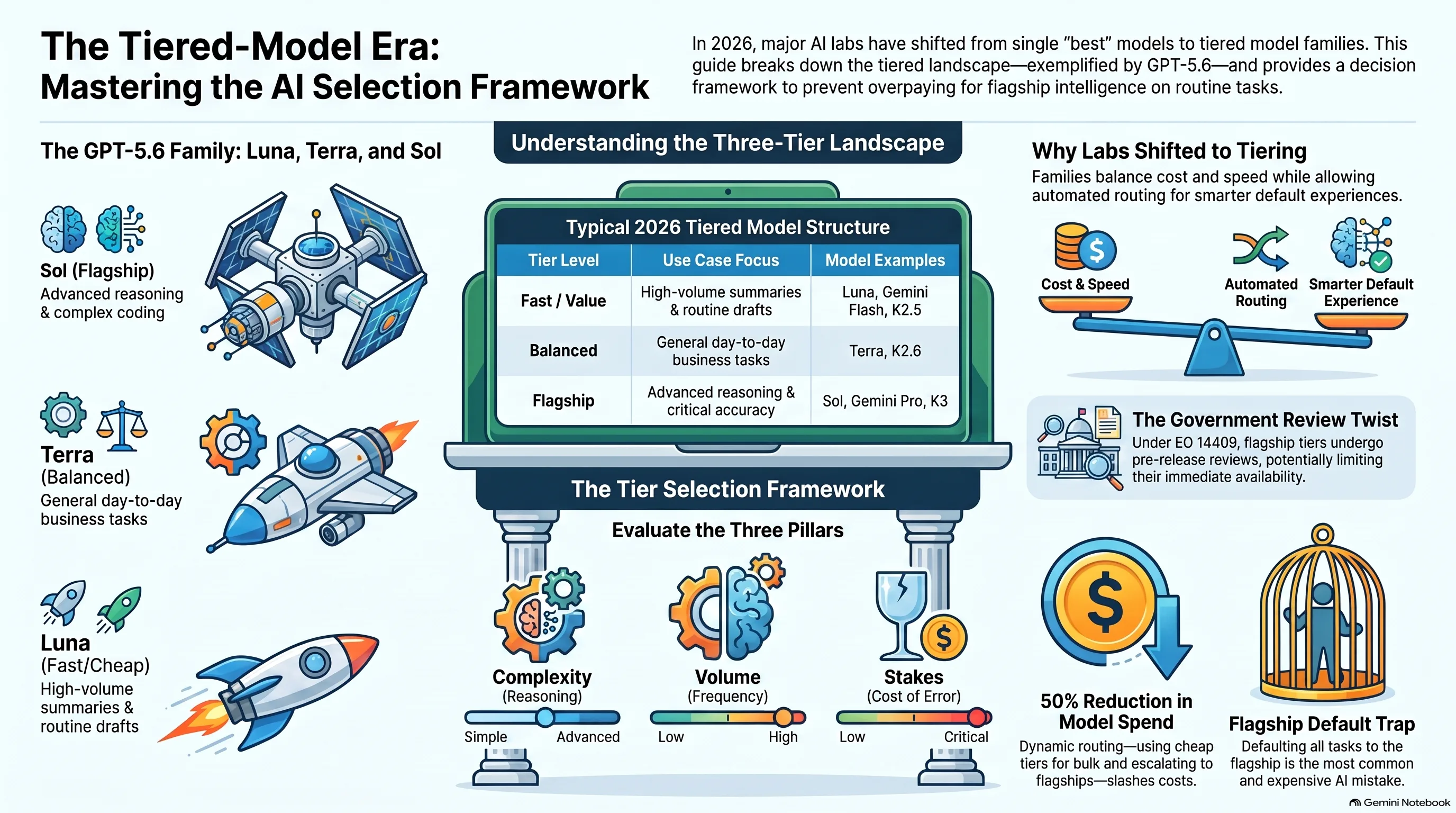
For years, picking an AI model meant picking one thing. In 2026, the top labs ship families—a spread of models under one name, each tuned for a different balance of cost, speed, and capability.
OpenAI's GPT-5.6, Google's Gemini 3.1, and Moonshot's Kimi all follow this pattern. That is good news: you no longer overpay for a flagship on tasks that never needed it. But it also means choosing well matters more than ever.
This guide explains why labs went tiered, the new government wrinkle in how top models launch, and a simple framework for matching the right tier to each job.
🧩 One Model Is Now Three
The single 'best model' has been replaced by a menu.
OpenAI's GPT-5.6, released in July 2026, is the clearest example. It comes in three tiers, from most cost-efficient to most capable:
- Luna — the cheapest and fastest, for high-volume everyday work
- Terra — the balanced middle for general tasks
- Sol — the flagship, state-of-the-art on coding, science, and hard reasoning
The others match the pattern: Google offers Gemini 3.1 in Flash and Pro tiers; Moonshot ships Kimi in value (K2.5), general (K2.6), and flagship (K3) tiers. Picking a 'model' now means picking a tier within a family.
🎯 Why Labs Went Tiered
This shift is about economics and user experience, not marketing.
- Cost. The flagship is expensive to run, and most queries—summaries, simple questions, routine drafts—do not need it. A cheaper tier serves them at a fraction of the price.
- Speed. Smaller tiers respond faster, which matters for interactive and high-volume use.
- Coverage. One family can serve a free consumer and an enterprise developer without forcing either into the wrong trade-off.
- Smarter defaults. Increasingly the product decides for you—routing easy questions to a fast tier and hard ones to the flagship, so users stop switching models manually.
That last trend is the real story of 2026: the value is not another model name, but advanced capability quietly wired into the default experience.
🏛️ The Government Twist
The GPT-5.6 launch also marked a new reality: frontier models now pass through government review.
Under US Executive Order 14409 (June 2026), the most capable models undergo a classified pre-release review. GPT-5.6 actually launched in a limited preview at the government's request before its full public release, and Anthropic's top models were briefly restricted under export controls.
For buyers, the practical takeaways are simple: the most powerful tiers may face access limits or delays, availability can differ by region, and open-weight alternatives—exempt from this review—are becoming a more predictable option for some use cases. It is worth knowing when you standardize on a model.
🧮 A Framework to Pick the Right Tier
You do not need to track every model name. You need a way to match the tier to the job. Weigh three factors:
- Complexity — is this a simple, well-defined task or ambiguous, multi-step reasoning?
- Volume — are you running this thousands of times a day, or occasionally?
- Stakes — what does a wrong answer cost?
Then route accordingly:
- Low complexity, high volume, low stakes — use the cheapest tier (Luna, Flash, K2.5) for classification, summaries, and routine drafts
- Medium complexity or stakes — use the balanced tier (Terra, K2.6) for most day-to-day business tasks
- High complexity or stakes — use the flagship (Sol, Gemini Pro, K3) for hard reasoning, critical accuracy, and complex code
Defaulting everything to the flagship is the most common—and most expensive—mistake.
🔀 Model Routing in Practice
The teams getting the most from AI in 2026 do not pick one model and stop. They route dynamically:
- A cheap tier handles the bulk of requests
- A classifier or simple rules escalate hard cases to the flagship
- Costs drop sharply because the expensive model runs only when it is actually needed
This mirrors basic ROI discipline: use the right tool for each task, not the most powerful tool for every task. A single well-designed routing layer often cuts model spend by more than half with no visible drop in quality, because most work never needed the flagship in the first place.
Start simple—two tiers and a clear rule for when to escalate—then refine as you learn where quality actually requires more horsepower.
Key Takeaways
Quick wins and actionable insights from this guide:
- Top labs now ship model families, not single models: GPT-5.6 (Luna/Terra/Sol), Gemini (Flash/Pro), Kimi (K2.5/K2.6/K3)
- Tiering exists for cost, speed, and coverage—and increasingly the product routes queries automatically
- Under US EO 14409, frontier models face pre-release review; the most capable tiers may see access limits, while open-weight models are exempt
- Pick a tier by weighing task complexity, volume, and stakes
- Defaulting every task to the flagship is the most common and most expensive mistake
- Model routing—cheap tier for the bulk, flagship for hard cases—often cuts model spend by half with no quality loss
Sources & Further Reading
This article is based on the following recent research, reporting, and primary sources:
- 1OpenAI GPT-5.6 launches publicly as a three-tier model family after US government review — GCN
- 2The Trump Administration Has Created a De Facto Licensing System for Frontier AI Models — Center for American Progress
- 3Frontier AI Models Now Face a Secret Government Review — AI Tool Briefing
- 4Weekly AI Model Update: OpenAI Broadens GPT-5.6 Access (Aug 2026) — 404K Research
AI 101 Services Team
AI Strategy & Research
AI 101 Services helps service businesses implement AI automation solutions that deliver measurable ROI. With 21+ solutions delivered and 15+ clients served, we specialize in turning manual chaos into streamlined digital workflows.