Your phone rings at 6:47 PM. Your team left at 5. A potential customer hears silence, hangs up, and calls your competitor instead.
This happens thousands of times daily across small businesses in Australia. Missed calls mean missed revenue—and hiring a full-time receptionist to cover every hour isn't realistic for most small businesses.
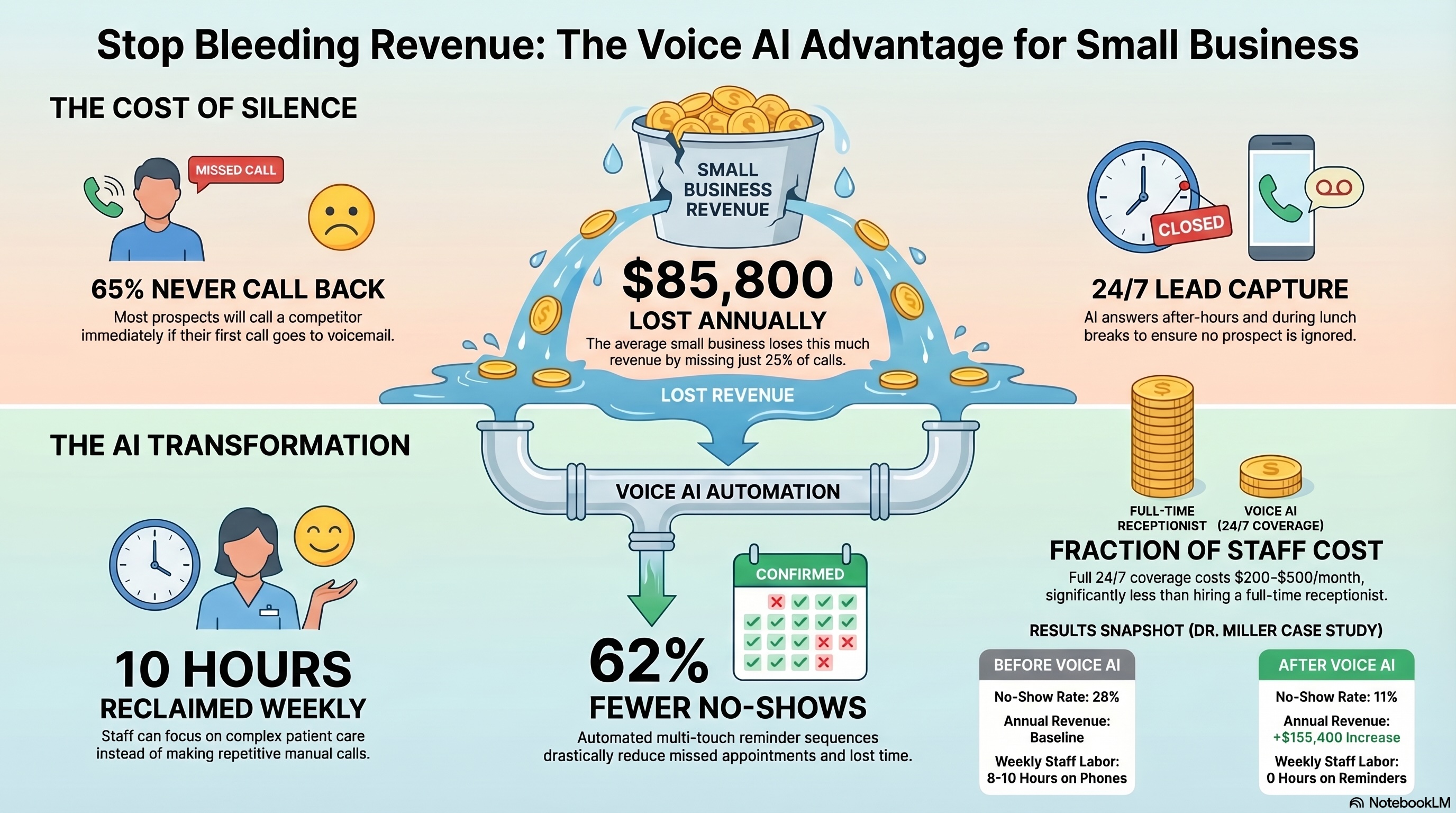
Voice AI changes the equation entirely. Modern AI voice agents sound natural, handle complex conversations, and work 24/7 for a fraction of the cost of a single employee. Dr. Miller Chiropractic Center deployed one and reduced no-shows by 62% while recovering $155,400 in annual revenue.
This guide shows you exactly how voice AI works for small businesses, what it costs, and how to implement it without your customers ever feeling like they're talking to a robot.
📞 The Missed Call Problem: How Much It's Really Costing You
Let's put real numbers to the problem.
Average small business:
- Receives 30-50 calls per day
- Misses 20-30% of inbound calls (after hours, lunch breaks, staff busy)
- Each missed call has a 60-70% chance of never calling back
The Math:
- 40 daily calls × 25% missed = 10 missed calls/day
- 10 missed × 65% never return = 6.5 lost prospects/day
- 6.5 × 22 business days = 143 lost prospects/month
- At even a 10% conversion rate with $500 average value = $7,150/month lost
That's $85,800 annually walking out the door because nobody picked up the phone.
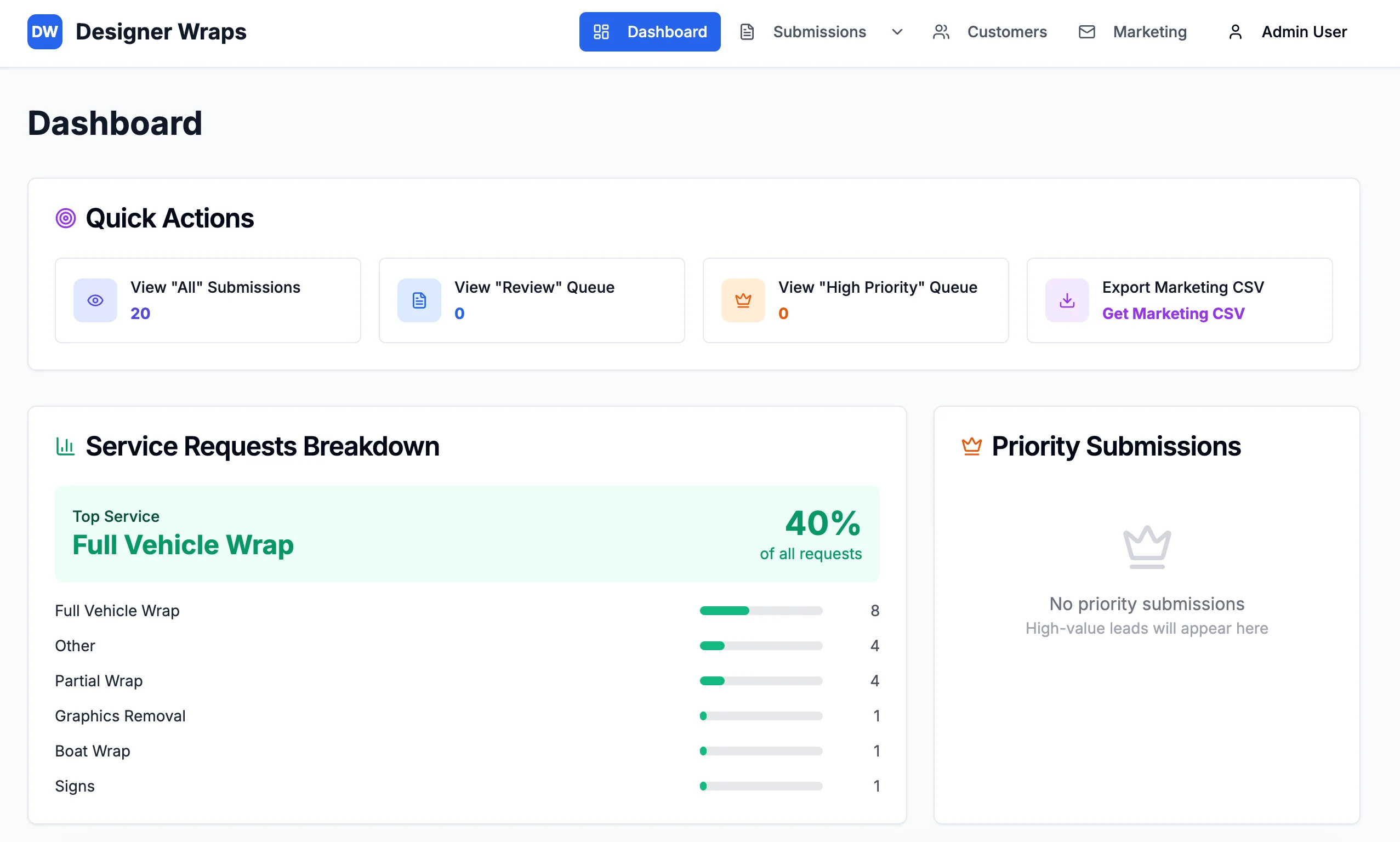
Designer Wraps was experiencing exactly this—potential customers calling for vehicle wrap quotes but reaching voicemail during peak hours. Their AI-powered lead capture system now responds to every inquiry within seconds, achieving 87% faster lead response times.
Warning Sign: If your voicemail has more than 5 messages at the end of each day, you're bleeding revenue.
🤖 How Modern Voice AI Actually Works (It's Not What You Think)
Forget the robotic "press 1 for sales" systems from 2010. Modern voice AI is fundamentally different.
What happens when a customer calls:
- AI answers in a natural, conversational voice within 1-2 rings
- It understands context—"I need to reschedule my Thursday appointment" triggers the right workflow
- It asks intelligent follow-up questions based on the conversation
- It can book appointments, answer FAQs, capture lead information, or transfer to a human
- It sends a summary to your team via email or SMS instantly
The Technology Behind It:
- Speech-to-text converts caller's words in real-time
- Natural language processing understands intent, not just keywords
- Text-to-speech generates human-like responses with natural cadence
- Integration layer connects to your calendar, CRM, and booking system
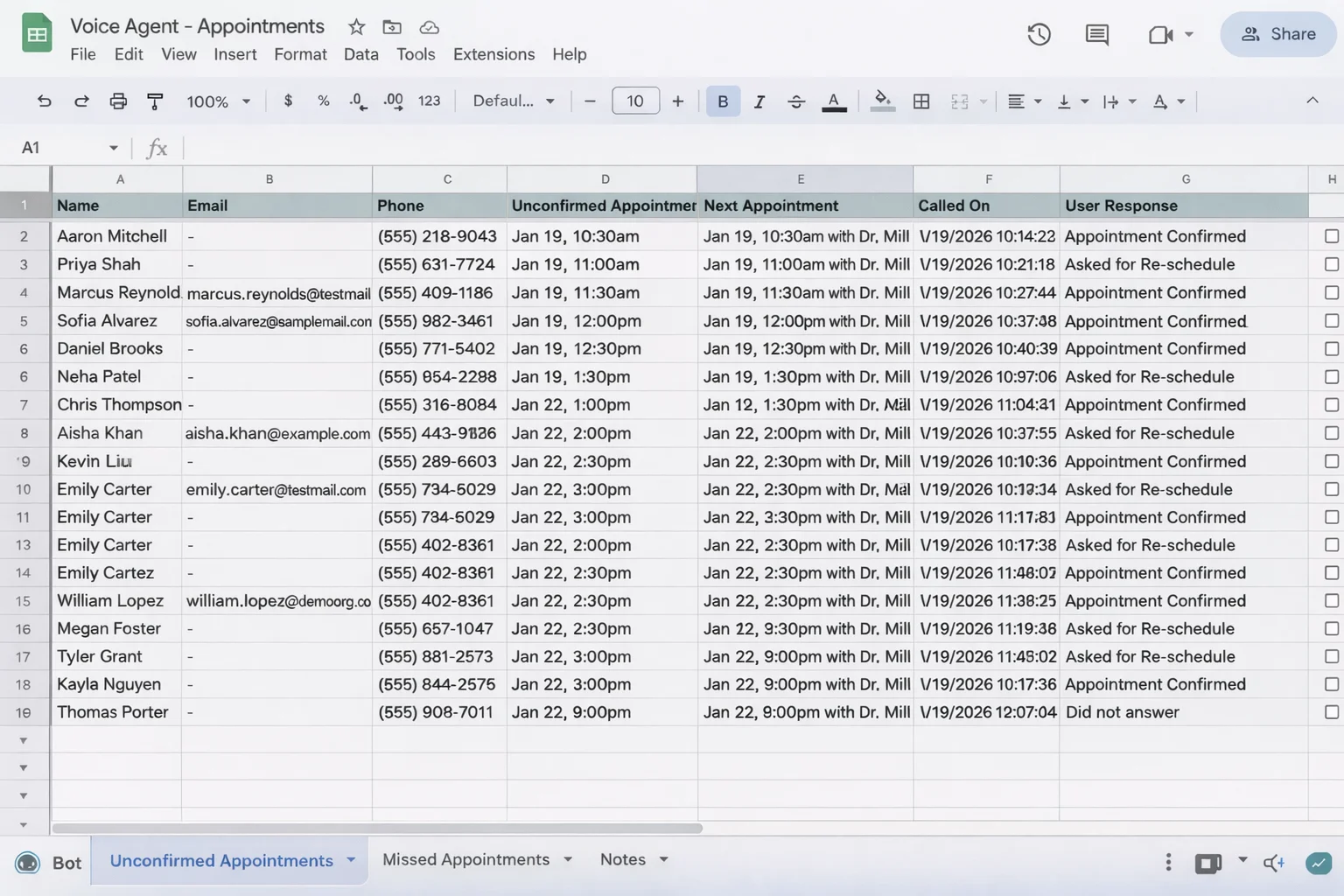
The Result? Dr. Miller's AI voice agent handles 200+ calls weekly—appointment confirmations, rescheduling requests, and follow-ups—with patients often not realizing they're speaking with AI.
🏥 Real Results: Dr. Miller's Voice AI Transformation
Dr. Miller Chiropractic Center was the classic case of a successful practice drowning in phone work.
Before Voice AI:
- Staff spent 8-10 hours weekly making confirmation calls
- No-show rate: 28% (industry average: 20-30%)
- Calls only happened during business hours when patients couldn't answer
- Staff constantly pulled away from patient care to answer phones
After Voice AI:
- AI handles all appointment reminders automatically
- Calls at optimal times—evenings and weekends when patients actually answer
- Multi-touch sequence: 48hr → 24hr → 2hr reminders
- Automated follow-up for no-shows with immediate rebooking option
The Numbers:
- No-shows dropped from 28% to 11% (62% reduction)
- Revenue increased by 22% ($155,400 annually)
- Staff reclaimed 8-10 hours weekly for patient care
- ROI achieved in under 3 months
The voice agent didn't replace the team—it freed them to do what they were actually hired for: helping patients.
📋 5 Voice AI Use Cases Every Small Business Should Consider
Voice AI isn't just for healthcare. Here are the highest-impact applications:
1. Appointment Reminders & Confirmations Reduce no-shows by 40-60% with persistent, personalized reminder sequences. Works for any appointment-based business: medical, dental, trades, consulting, salons.
2. After-Hours Call Handling Capture every lead that calls outside business hours. The AI collects their information, answers common questions, and books appointments—then sends your team a summary.
3. Outbound Follow-Up Calls Automatically call leads who filled out a form, patients who missed appointments, or customers due for service. Scale from 10 to 1,000 calls without hiring.
4. FAQ Handling & Call Routing "What are your hours?" "Where are you located?" "Do you accept my insurance?" AI handles the repetitive questions so your team handles the complex ones.
5. Lead Qualification AI asks qualifying questions, scores the lead, and only transfers high-value prospects to your sales team. No more wasting time on bad-fit inquiries.
Warning Sign: If any of these scenarios describe your daily reality, voice AI can likely deliver ROI within the first month.
💰 What Voice AI Actually Costs (And Why It Makes Sense)
Let's be transparent about pricing, because it's more accessible than most businesses expect.
Setup Costs:
- Platform integration and call script development: $3,000-8,000
- Calendar/CRM integration: Typically included
- Custom voice training: Included with most platforms
- Timeline: 2-4 weeks from decision to live
Ongoing Costs:
- Per-minute usage: $0.15-0.35/minute (varies by platform)
- Monthly platform fee: $100-400 depending on call volume
- Typical monthly total for small business: $200-500
What Your Team Gains Back:
The real value isn't cost savings—it's what your team can do with the time they reclaim.
- Dr. Miller's staff reclaimed 8-10 hours weekly to focus on patient care instead of making repetitive calls
- Receptionists handle complex inquiries and build relationships instead of routine confirmations
- After-hours coverage means your team isn't stretched thin covering every time slot
Voice AI handles the repetitive, high-volume calls—appointment reminders, basic FAQs, after-hours capture—so your team can focus on the conversations that actually require a human touch: complex questions, upset customers, and relationship building.
The Result? Dr. Miller's practice runs more smoothly because the AI and the team each do what they're best at. The AI handles volume and consistency. The humans handle empathy and judgment.
🚀 Getting Started: Your 3-Week Implementation Plan
Define Your Use Case
Start with ONE high-impact scenario—don't try to automate everything at once.
Best starting points ranked by typical ROI:
- Appointment reminders (highest ROI for appointment-based businesses)
- After-hours call capture (highest ROI for lead-based businesses)
- Outbound follow-ups (highest ROI for businesses with large customer lists)
Build and Test
Work with your implementation partner to:
- Write call scripts based on your most common phone interactions
- Integrate with your booking/CRM system
- Test with internal team members to refine responses
- Set up call recording for quality assurance
Pilot Launch
Start with a small segment—50 appointments or after-hours calls only.
- Monitor call recordings for quality
- Check customer feedback
- Measure key metrics (answer rate, completion rate, conversion rate)
- Adjust scripts based on real interactions
Once your pilot shows results (most do within the first week), roll out to full operation.
The Result? Most businesses go from zero to fully operational voice AI in 3-4 weeks, with measurable ROI in the first month.
💡 See These Strategies in Action
Real businesses, real results. Explore how companies implemented these concepts:
Key Takeaways
Quick wins and actionable insights from this guide:
- Missed calls cost the average small business $85,000+ annually in lost leads
- Modern voice AI sounds natural—patients and customers often can't tell the difference
- Dr. Miller reduced no-shows by 62% and recovered $155,400 annually with voice AI
- Voice AI costs $200-500/month and frees your team to focus on high-value conversations
- Start with one high-impact use case: reminders, after-hours capture, or follow-ups
- Implementation takes 3-4 weeks from decision to live system with measurable ROI in month one
AI 101 Services Team
Voice AI Specialists
AI 101 Services helps service businesses implement AI automation solutions that deliver measurable ROI. With 21+ solutions delivered and 15+ clients served, we specialize in turning manual chaos into streamlined digital workflows.