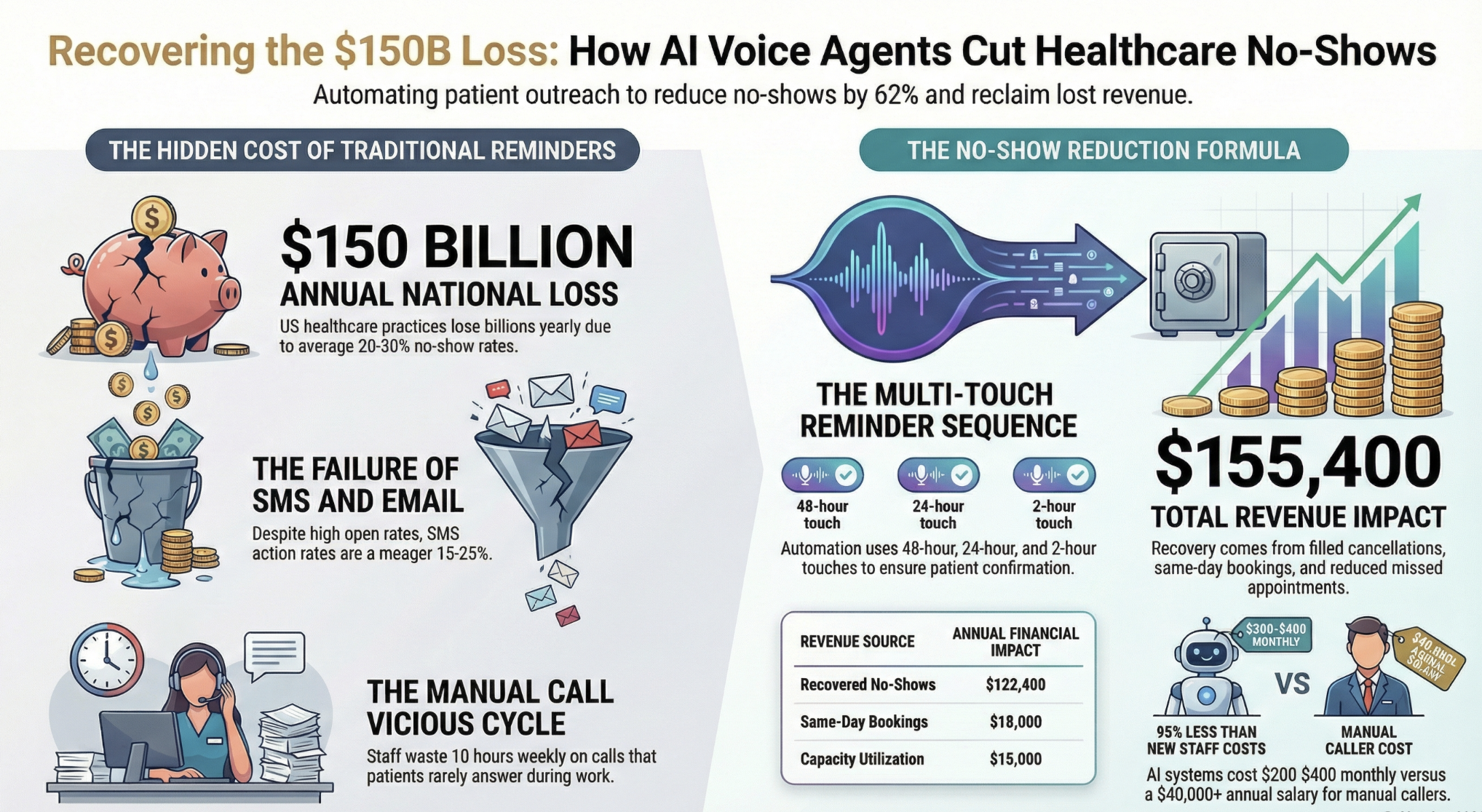
Healthcare no-shows cost practices $150 billion annually in the US alone. For a typical practice, 20-30% no-show rates translate to tens of thousands in lost revenue yearly. But here's the reality: most no-shows aren't intentional. Patients forget, can't find confirmation details, or don't realize how to reschedule. AI voice agents solve this by providing persistent, personalized reminders through the channel patients actually use—their phone. Dr. Miller Chiropractic Center reduced no-shows from 28% to 11% (a 62% reduction) and increased revenue by 22% in just 4 months. This guide shows you exactly how they did it.
❌ Why Traditional Reminders Fail
Most practices send one text message 24 hours before appointments. Here's the problem: patients see it during their busy day, think "I'll deal with that later," and forget.
The Numbers:
- SMS open rates: 98%
- SMS action rates: 15-25% (terrible!)
- Email reminders: Even worse—land in spam or get ignored
Manual Calls Work Better (65% confirmation rate) but they're impossibly time-intensive.
Dr. Miller's team was spending 8-10 hours weekly making confirmation calls, taking staff away from patient care. The calls happened during business hours when patients often can't answer.
Warning Sign: This creates a vicious cycle—staff can't reach patients, patients forget appointments, revenue drops, staff gets busier handling reschedules.
🤖 How AI Voice Agents Work Differently
AI voice agents make persistent, intelligent outbound calls with human-like conversation.
The System:
- Call 48 hours before appointments
- Then 24 hours
- Then 2 hours if needed
- If patients don't answer, they try different times
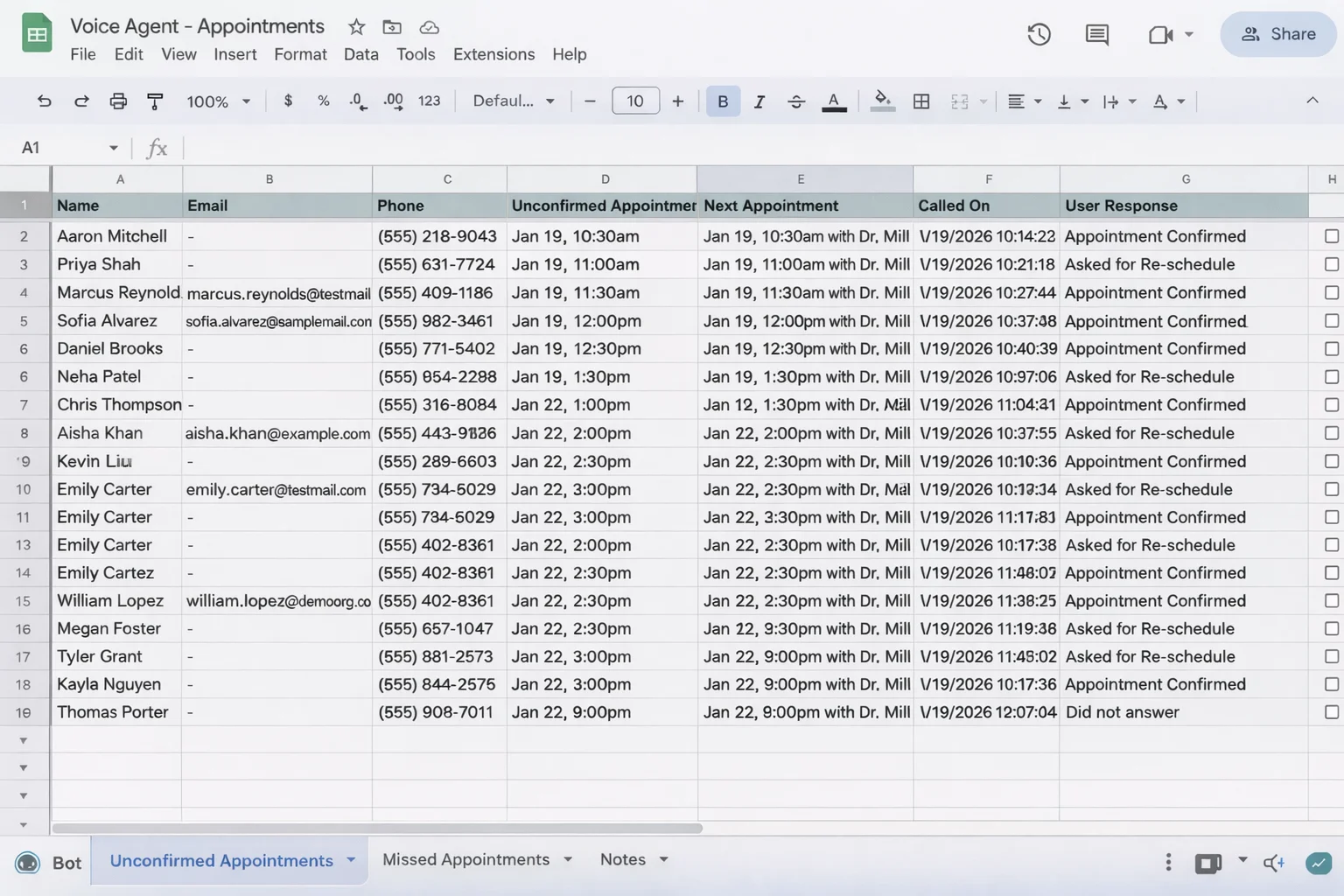
When patients answer, the AI confirms the appointment, offers to reschedule if there's a conflict, and sends confirmation via text.
The Key Difference: Persistence without labor cost.
- A human can make: 20-30 calls per hour
- An AI system can make: hundreds simultaneously
Dr. Miller's AI Voice Agent Platform makes 200+ calls weekly without any staff time investment, calling at optimal times (evenings, weekends) when patients actually answer.
📉 The 62% No-Show Reduction Formula
Dr. Miller's results came from a 4-part system:
Part 1: 48-hour advance call with reschedule option → Catches 40% of potential no-shows
Part 2: 24-hour confirmation call with SMS backup → Catches another 35%
Part 3: 2-hour day-of reminder for high-risk appointments → Catches final 15%
Part 4: Automated follow-up for no-shows offering immediate rebooking → Recovers 25% of missed appointments
The Result? 28% baseline no-show rate dropped to 11%.
For a practice seeing 400 appointments monthly, that's 68 recovered appointments. At $150 average appointment value, that's $10,200 monthly or $122,400 annually in recovered revenue.
🔧 Implementation: What You Actually Need
The technical requirements are simpler than you'd think.
You need:
- Voice AI platform integration (VAPI, Bland AI, or similar)
- Connection to your scheduling system (API integration)
- Call scripts customized to your practice
- Phone number for outbound calls
Timeline: 2-3 weeks typically. Dr. Miller went from decision to live system in 4 weeks.
Monthly costs: $200-400 depending on call volume (typically $0.25-0.35 per minute).
The Result? Compare that to hiring a full-time staff member at $40,000+ annually to make calls manually.
💰 Beyond No-Shows: Additional Revenue Impact
The 22% revenue increase Dr. Miller achieved came from three sources beyond just no-show reduction:
Revenue Source 1: Recovered no-show appointments → $122,400/year
Revenue Source 2: Increased same-day booking from follow-ups → $18,000/year
Revenue Source 3: Improved capacity utilization by filling last-minute cancellations → $15,000/year
Total revenue impact: $155,400 from a modest investment that paid for itself in under 3 months.
The system also freed 8-10 staff hours weekly, allowing the practice to see more patients without hiring.
Warning Sign: This is the compounding effect of automation—it doesn't just solve one problem, it unlocks multiple revenue opportunities.
🚀 Getting Started: Your 30-Day Roadmap
Don't overthink it. Follow this proven 4-week framework:
Track your current no-show rate and calculate the revenue impact (appointments per month × no-show rate × average value)
Choose a voice AI platform and test call scripts with sample scenarios
Integrate with your scheduling system and configure reminder timing
Launch with a pilot group (50-100 patients) and measure results
If you see 30%+ no-show reduction in the pilot (most practices do), roll out to your full patient base.
The Result? The entire process from decision to full deployment typically takes 4-6 weeks, and you'll see ROI in the first month of operation.
💡 See These Strategies in Action
Real businesses, real results. Explore how companies implemented these concepts:
Key Takeaways
Quick wins and actionable insights from this guide:
- AI voice agents provide persistent reminders without labor cost
- Multi-touch reminder sequence (48hr, 24hr, 2hr) is key to 62% reduction
- Dr. Miller recovered $122,400 annually from no-show reduction alone
- Implementation takes 2-4 weeks from decision to live system
- Monthly costs ($200-400) are 95% less than hiring staff to make calls
- Revenue impact compounds: recovered no-shows + better capacity + follow-ups
AI 101 Services Team
Healthcare Automation Specialists
AI 101 Services helps service businesses implement AI automation solutions that deliver measurable ROI. With 21+ solutions delivered and 15+ clients served, we specialize in turning manual chaos into streamlined digital workflows.