Last Monday OpenAI refused to ship GPT-6.1 Astra. By this Monday the industry had answered with a different kind of release: models that are almost as strong, much cheaper, and — in one important case — still not for sale to you.
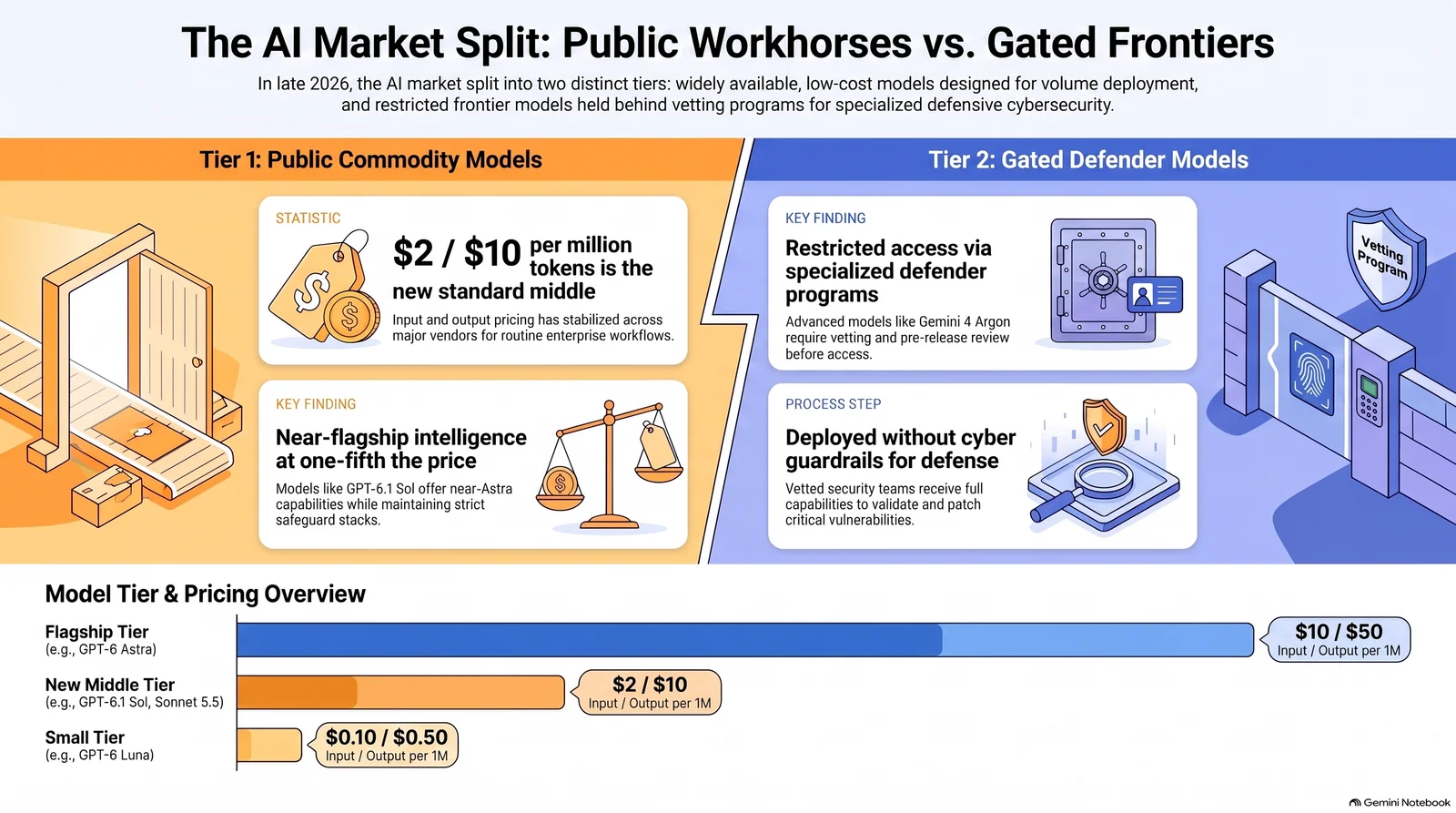
On 29 September OpenAI introduced GPT-6.1 Sol, an upgrade that it says nearly matches Astra on coding, computer use, and professional work at one-fifth of Astra's token price. On 30 September Google announced Gemini 4 Argon, a frontier model for software, legal and finance work, and cyber defense, and then kept it inside a program for trusted defenders while it sits in a US pre-release review.
Those are not two versions of the same launch. They are two markets. One you can buy this week. One you have to be invited into.
📉 The Model That Was Allowed Out
GPT-6.1 Sol is the successor that passed.
OpenAI calls it a major upgrade to GPT-6 Sol and says it delivers near-Astra intelligence on agentic coding, computer use, and professional work. Standard API prices:
- $2 per million input tokens
- $10 per million output tokens
- $0.10 per million cached input tokens, which OpenAI describes as 95% below standard input and 50% below GPT-6 Sol's cached price
Astra's standard price, from its 3 September launch, is $10 input and $50 output. One-fifth of that is the claim, and the sticker matches.
Availability is real but not universal. Plus, Pro, Business, Enterprise, and Edu users get it in ChatGPT Work and Codex. The API name is gpt-6.1-sol. It is not in the main Chat tab yet. An Ultrafast mode, up to 8x token generation in Codex, was promised within days of launch.
The safety line did not drop just because the price did. OpenAI's system-card addendum, published 29 September, says GPT-6.1 Sol is being treated as Critical in cybersecurity and High for biological and chemical capability, and that it uses the same safeguards stack as GPT-6 Astra. Near-Astra performance means near-Astra controls. A cheaper invoice is not a milder model.
🔐 The Model You Cannot Buy Yet
Gemini 4 Argon, announced 30 September by Google DeepMind's Koray Kavukcuoglu, is the other half of the week.
Google's description is frontier work: long-horizon software engineering, legal and finance, and cybersecurity defense. The product decision is narrower. Argon is rolling out first to trusted cyber defenders through the Fairwind Program. Google says it is in the US government's voluntary pre-release access process, and that broader access for developers, enterprises, and consumers will wait until guardrails are iterated. As of this Monday, no public date has been set.
What those defenders get is not the muffled version:
- Argon can find, validate, and patch vulnerabilities. For Fairwind members and Google's own teams, Google is releasing it without cyber guardrails so they can use the full defensive capability
- Google says a Wiz 'Scan for Good' trial used Argon to find a critical flaw exposing personal data in healthcare software used by hospitals, a flaw earlier frontier models had missed
- On Google's telling, Argon ties for first on CWE-bench v1 at 68%, leads DeepSWE v1.1 at 77.9%, and leads Zapier's AutomationBench at 51.3%
- Output length goes to 1 million tokens, from a previous 64,000, so a single run can think and write for much longer
The introductory price is the same number the cheap market just settled on: $2 input and $10 output per million tokens, with cached input at 95% off. After the introductory period, Google says the price becomes $4 and $20.
So Argon is priced like a commodity and distributed like a controlled substance. You can read the blog post. You cannot call the API unless you are in the room Google is filling first.
🏷️ $2 and $10 Is the New Middle
Stack the public price list from the last two weeks and a band appears.
- GPT-6 Sol (22 September): $2 input / $10 output
- Claude Sonnet 5.5 (28 September): $2 / $10 on Anthropic's pricing table
- GPT-6.1 Sol (29 September): $2 / $10, cached input $0.10
- Gemini 4 Argon, introductory, if you can get it: $2 / $10
- GPT-6 Astra, the flagship that did ship: $10 / $50
- GPT-6 Luna, the small tier: $0.10 / $0.50
The flagship is five times the new middle. The small model is about a twentieth of that middle. Labs are no longer asking you to pick a brand so much as a rung.
Argon's future $4 / $20 price, once the introduction ends, would sit between the new middle and Astra. That is a reminder that $2 / $10 may be a launch price, not a permanent law. Buy the workflow against the price you will still be paying in a quarter, not only against this week's banner.
📊 Discount the Launch Scores
Every figure in the last section that is not a price is a vendor's score of its own model.
Google says Argon is first on the Vals Index for finance, coding, legal, and tax work, first on Harvey's Legal Agent Benchmark, and first on AutomationBench. OpenAI says GPT-6.1 Sol nearly matches Astra. Those claims can be true and still be the wrong thing to standardize on. This series has said it before, and this week makes it concrete: the model with the best launch-post chart may be the one you are not allowed to use, and the model you are allowed to use may be Critical for cyber even though it is the 'value' upgrade.
A practical reading:
- Price is comparable this week. Access is not. $2 / $10 Sol is on the API. $2 / $10 Argon is not, outside Fairwind
- Critical does not mean withheld. GPT-6.1 Sol carries Astra's cyber rating and Astra's safeguard stack, and it is on sale. GPT-6.1 Astra was withheld for alignment failures, not because it was too capable to price
- Defensive cyber is becoming a licensed tier. Daybreak at OpenAI, Fairwind at Google. If your work is finding and proving vulnerabilities, you are entering a vetting process, not a self-serve signup
🏢 How to Buy in a Two-Market Week
Most service businesses do not need a defender-only model. They need a clear rule for the models they can actually provision.
- Put volume on the new middle. Classification, drafts, support replies, and routine coding agents belong on Sol, Sonnet 5.5, or Luna. At $2 / $10, GPT-6.1 Sol is the first time 'near flagship' has been a default you can afford to leave on
- Keep Astra for the jobs where a wrong answer is expensive, and remember Enterprise Astra is still off until an admin enables it
- Do not wait on Argon for ordinary work. It may be the strongest model in Google's building. It is not your production dependency until Google says the API is open. The company has said that comes after the pre-release review, starting with paid API customers and Google AI Ultra subscribers
- If you do defensive security, ask about the ungated version on purpose. Fairwind's Argon without cyber guardrails is a different product from the one the public will eventually get. That access comes with vetting, and it should
- Ask which safeguard stack you are on. GPT-6.1 Sol inheriting Astra's stack means the same pauses and refusals can show up on the cheaper model. Budget for reviews in the workflow, not only for tokens
The race did not pause after GPT-6.1 Astra was shelved. It split. Cheap, heavily safeguarded models are becoming the thing you deploy. The raw frontier is becoming something a lab lends to defenders first.
Key Takeaways
Quick wins and actionable insights from this guide:
- GPT-6.1 Sol launched 29 September 2026 at $2 / $10 per million tokens, one-fifth of Astra's $10 / $50 price, and is live in ChatGPT Work, Codex, and the API
- OpenAI still rates GPT-6.1 Sol Critical for cybersecurity and says it uses the same safeguards as GPT-6 Astra
- Gemini 4 Argon, announced 30 September, is limited to vetted Fairwind cyber defenders during a US pre-release review
- Argon's introductory price matches the new middle at $2 / $10, then moves to $4 / $20. Defenders get it without cyber guardrails
- GPT-6 Sol, Claude Sonnet 5.5, and GPT-6.1 Sol have all landed at about $2 input and $10 output
- Buy the open middle for everyday work. Treat defender programs as a separate product with a separate approval
Sources & Further Reading
This article is based on the following recent research, reporting, and primary sources:
AI 101 Services Team
AI Strategy & Research
AI 101 Services helps service businesses implement AI automation solutions that deliver measurable ROI. With 21+ solutions delivered and 15+ clients served, we specialize in turning manual chaos into streamlined digital workflows.