You won the discovery call. The client wants a proposal by Friday. Now you're staring at a blank document, digging through old files for pricing, rewriting scope sections you've written a dozen times, and wondering why winning business still means losing evenings.
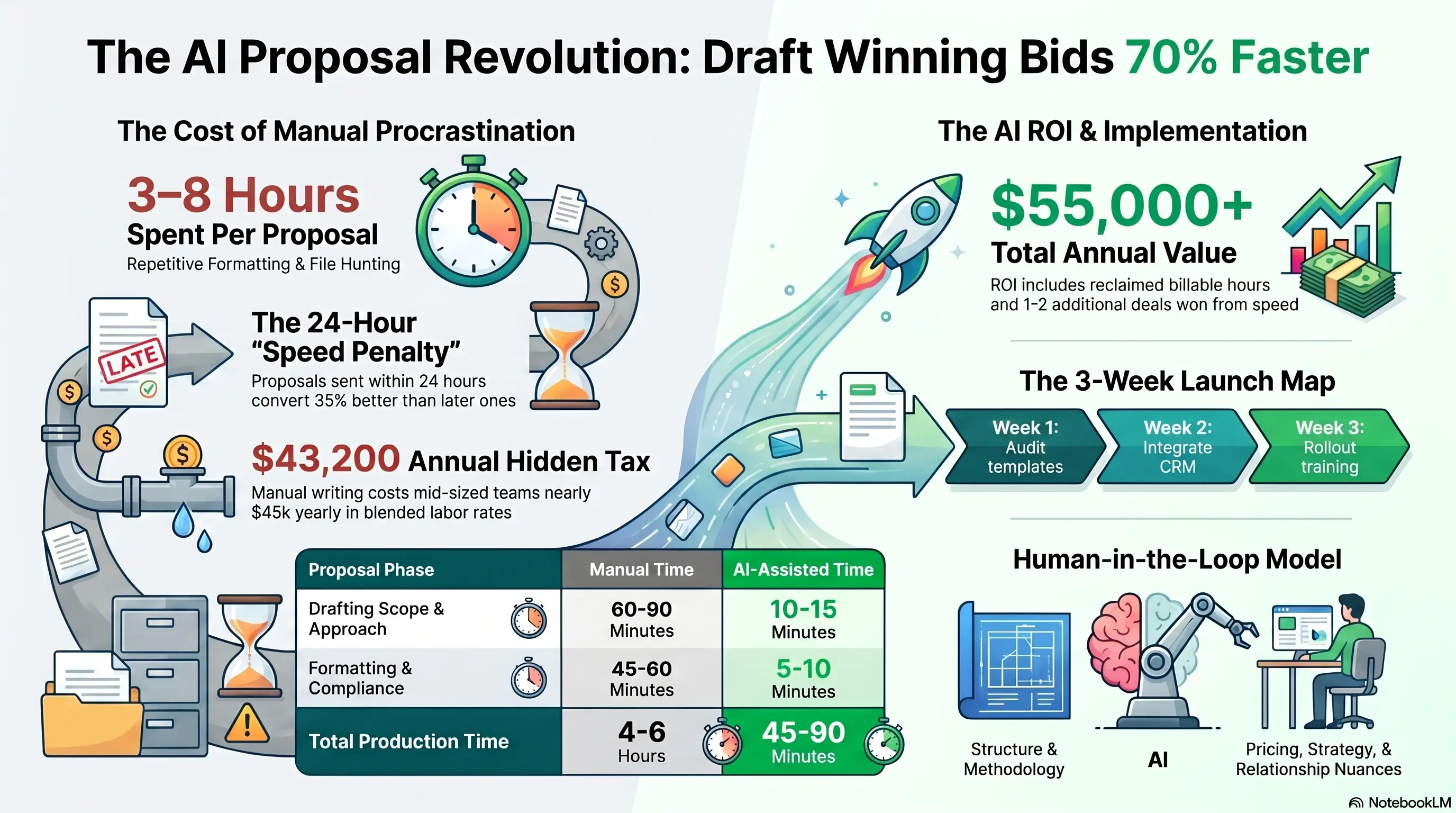
Consultants and agencies spend 3-8 hours per proposal on work that doesn't require their expertise—formatting, copying scope language, and hunting for the right case study. That's 15-40 hours weekly for teams sending 5+ proposals, time that should go toward delivery and sales conversations.
AI-assisted proposal writing doesn't replace your judgment. It drafts the structure, pulls from your template library, and handles repetitive sections—so you review, refine, and send in 30-60 minutes instead of half a day.
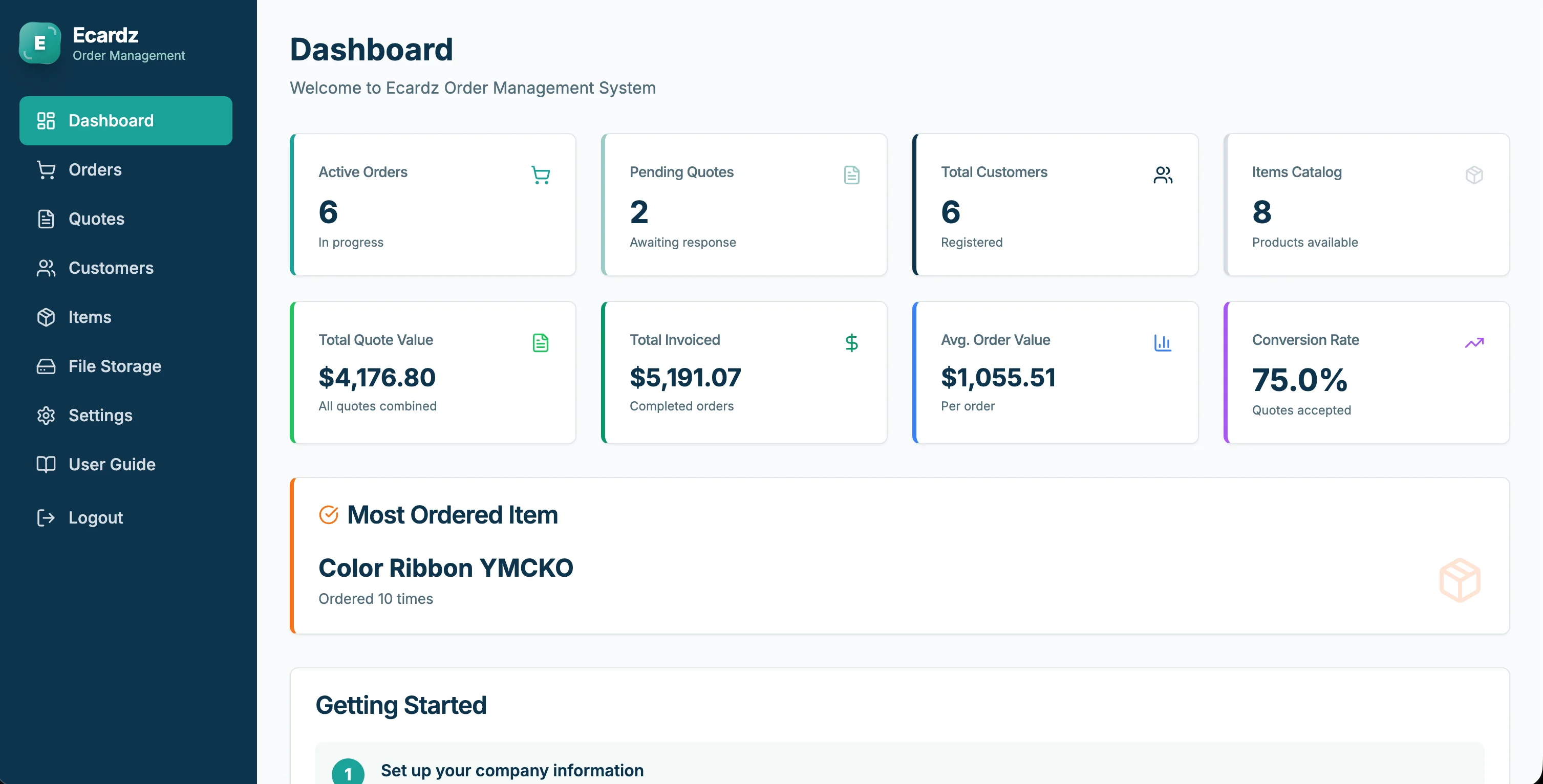
Ecardz cut quote creation time by 70% with structured automation. The same principles apply to proposals: templates, smart drafting, human review. This guide shows consultants and agencies how to build an AI proposal workflow that keeps your voice and wins more deals.
⏱️ The Time Cost of Manual Proposals
Manual proposals consume far more time than most agencies track.
Typical Proposal Breakdown (4-6 hours per proposal):
- Discovery notes review and scope definition: 45-90 minutes
- Pricing and timeline calculation: 30-60 minutes
- Writing executive summary and approach: 60-90 minutes
- Customizing case studies and team bios: 30-45 minutes
- Formatting, proofreading, and brand compliance: 45-60 minutes
- Internal review and revisions: 30-60 minutes
For a team sending 8 proposals monthly:
- 32-48 hours/month on proposal writing alone
- At $75/hour blended rate = $28,800-43,200/year
- Opportunity cost: those hours could close 2-3 additional deals annually
The Speed Penalty: Proposals sent within 24 hours of discovery convert 35% better than those sent 3+ days later. Manual processes push most agencies past that window.
Warning Sign: If your team dreads proposal day or rewrites the same scope sections from scratch every time, you're paying a tax that AI-assisted drafting eliminates.
🤖 AI-Assisted Drafting: Human Reviews, AI Does the Heavy Lifting
The winning workflow isn't "AI writes the proposal." It's "AI drafts, human approves."
The AI-Assisted Proposal Workflow:
- Input discovery data — Paste call notes, RFP requirements, or CRM deal summary into your AI tool
- AI generates first draft — Executive summary, proposed approach, timeline, deliverables, and pricing structure based on your templates
- Human review and refine — Senior consultant edits strategy sections, adjusts pricing, adds relationship context AI can't know
- Brand and compliance check — Final pass for tone, legal terms, and client-specific requirements
- Send within 24 hours — Client receives a polished proposal while interest is still high
What AI Handles Well:
- Structuring scope from bullet-point notes
- Writing methodology sections from your standard approaches
- Generating timeline and milestone tables
- Drafting cover letters and executive summaries
- Adapting language for different industries from your template library
What Humans Must Own:
- Pricing decisions and margin protection
- Strategic recommendations specific to the client
- Relationship nuance and political context
- Final sign-off before sending
The Result? Teams using AI-assisted drafting cut proposal time from 4-6 hours to 45-90 minutes while maintaining—or improving—win rates because proposals go out faster.
📚 The Template Library Approach: Stop Reinventing Every Proposal
Your best proposals contain reusable gold. A template library turns that gold into a system.
Build Your Library in Four Layers:
Layer 1: Core Structure Standard proposal skeleton every document follows—cover page, executive summary, approach, timeline, pricing, terms, case studies, team.
Layer 2: Service Modules Pre-written scope sections for each service you offer. "SEO Audit Package," "Brand Strategy Engagement," "Implementation Sprint"—each with standard deliverables, timelines, and pricing tiers.
Layer 3: Industry Variants Adapt modules for verticals you serve. Healthcare compliance language differs from retail e-commerce. Store variants, not separate documents.
Layer 4: Proof Points Case study summaries, metrics, and testimonials tagged by industry, service type, and outcome. AI pulls the most relevant ones per proposal.
Ecardz Parallel: Their quote system uses a service catalog with pricing rules—not blank documents. Proposals work the same way: assemble from validated components instead of writing from zero.
Maintenance Rule: Update templates after every won deal (what worked) and lost deal (what was missing). Your library improves with every proposal cycle.
Warning Sign: If team members maintain personal proposal folders with "their version" of scope language, you have no single source of truth—and inconsistent pricing.
🎯 Keeping Your Brand Voice (Not Generic AI Slop)
The biggest fear with AI proposals: every document sounds the same—and not like you.
Voice Preservation Tactics:
Custom Instructions: Feed your AI tool a style guide: sentence length preferences, words you never use, tone (direct vs. consultative), and 2-3 examples of proposals you're proud of.
Human-Written Anchors: Keep these sections human-only: executive summary opening paragraph, strategic recommendation, and pricing rationale. AI drafts the supporting structure around your voice.
Review Checklist: Before sending, verify:
- Does this sound like us, not a chatbot?
- Are claims backed by our actual case studies?
- Is pricing consistent with our rate card?
- Would our best client recognize our approach?
The Generic Test: Remove the client name. If the proposal could be sent to anyone, it's too generic—regardless of whether AI or a junior staffer wrote it.
Training Your Team: AI proposal tools are only as good as the reviewer. Train senior staff on what to edit vs. accept. Junior staff should never send AI drafts without review.
The Result? Agencies that invest in voice guidelines and human review send proposals 70% faster without sacrificing the personality that wins trust.
💰 ROI: What Faster Proposals Are Worth
Investment:
- AI writing tool subscription: $20-100/month per user
- Template library setup: $2,000-5,000 (one-time)
- Workflow integration with CRM: $1,000-3,000
- Timeline: 2-3 weeks to full operation
Annual Savings (8 proposals/month team):
Time reclaimed: 3.5 hrs/proposal × 8 proposals × 12 months × $75/hr = $25,200/year
Win rate improvement: Faster turnaround wins 1-2 additional deals/year. At $15,000 average project value = $15,000-30,000/year
Reduced burnout: Senior consultants spend time on strategy, not formatting—retention value difficult to quantify but consistently cited.
Total annual value: $40,000-55,000+
Payback period: Under 2 months
Warning Sign: Don't measure ROI on time saved alone. A proposal sent Tuesday instead of Friday can be the difference between winning and losing—factor win rate into your calculation.
🚀 3-Week AI Proposal Writing Launch
Week 1: Audit & Template Build - Time-track your last 5 proposals—actual hours per section - Extract your 3 best won proposals into modular templates - Build service module library with standard scope, timeline, and pricing - Define brand voice guidelines and AI custom instructions
Week 2: Workflow & Integration - Configure AI tool with templates and style guide - Connect CRM so deal notes flow into proposal drafts - Run 2 test proposals: AI draft → senior review → compare against manual baseline - Refine templates based on what AI got wrong
Week 3: Team Rollout - Train team on draft-review-send workflow - Set SLA: proposals sent within 24 hours of discovery - Track time per proposal and win rate for 30 days - Iterate templates monthly from win/loss feedback
Quick Win: Start with proposals under $10,000 where scope is standardized. Prove the workflow on simpler deals before applying to complex RFPs.
The Result? Most agencies cut proposal production time by 60-70% within the first month—matching Ecardz's quote automation gains applied to professional services.
💡 See These Strategies in Action
Real businesses, real results. Explore how companies implemented these concepts:
Key Takeaways
Quick wins and actionable insights from this guide:
- Manual proposals take 3-8 hours each—teams sending 8/month spend 32-48 hours monthly on repetitive writing
- AI-assisted drafting with human review cuts proposal time to 45-90 minutes without sacrificing quality
- Template libraries with service modules, industry variants, and proof points eliminate starting from scratch
- Brand voice preservation requires style guides, human-written anchors, and mandatory senior review
- ROI includes $25,000+ in reclaimed time plus 1-2 additional wins from faster turnaround
- Launch in 3 weeks: build templates, configure AI workflow, train team on draft-review-send process
AI 101 Services Team
Business Automation Specialists
AI 101 Services helps service businesses implement AI automation solutions that deliver measurable ROI. With 21+ solutions delivered and 15+ clients served, we specialize in turning manual chaos into streamlined digital workflows.