Your monthly newsletter gets 18% open rates and zero booked calls. Meanwhile, prospects who inquired three weeks ago haven't heard from you since the initial reply.
Newsletters broadcast to everyone. Nurture sequences speak to one person at one stage of their buying journey—with the right message, at the right time, triggered by what they actually did.
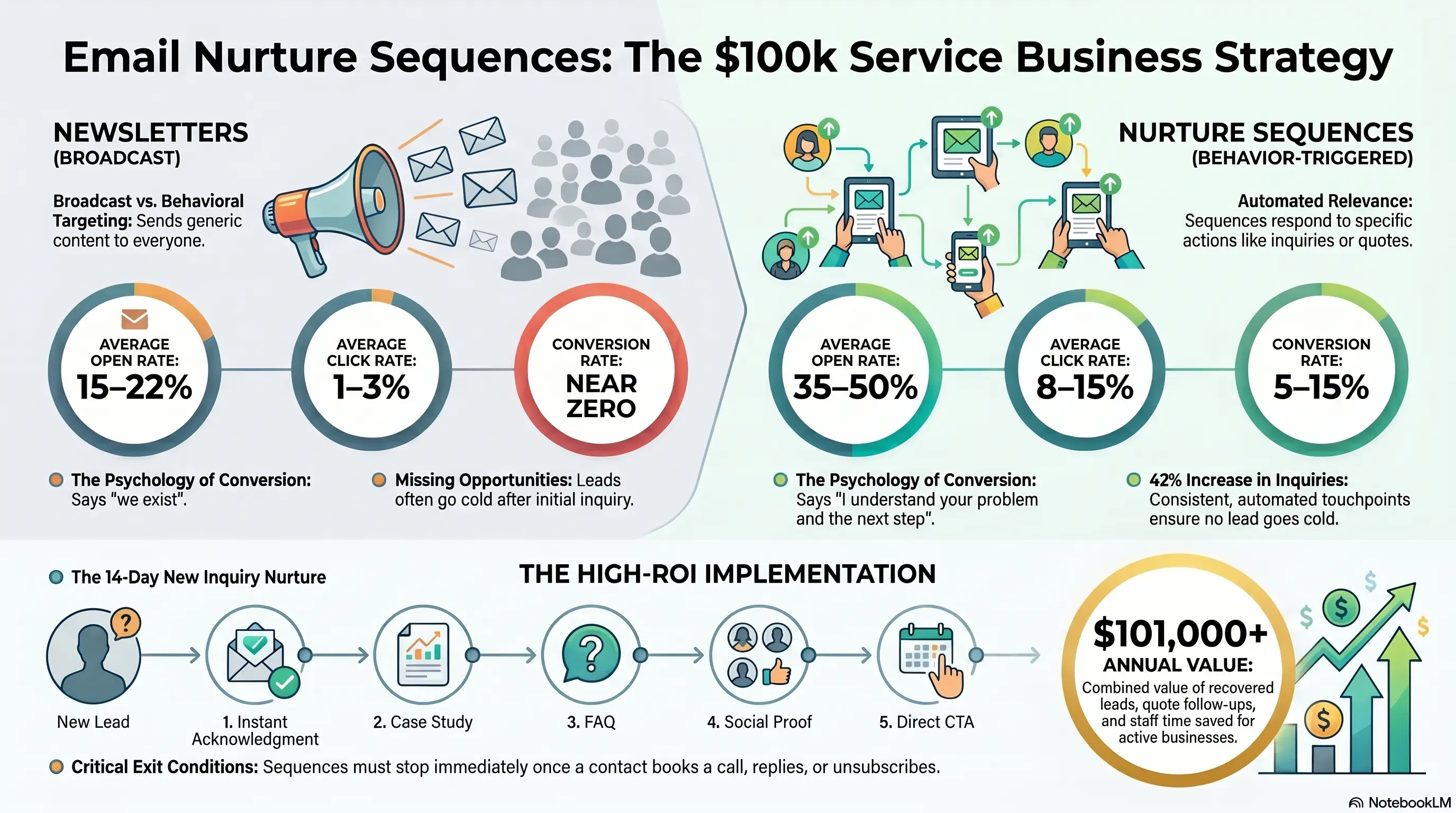
Consistent automated communication from a social media platform increased inquiries by 42% because every touchpoint was timed and relevant—not generic blasts hoping someone cares.
This guide shows service businesses how to build email sequences that convert: not "10 tips for spring cleaning" but "here's exactly why you should book a call this week."
📰 Newsletters vs Nurture Sequences: Why Most Email Fails
Most service businesses confuse email activity with email effectiveness.
Newsletter Approach (Low Conversion):
- Same content sent to entire list monthly
- Generic topics unrelated to where reader is in buying journey
- No trigger—sent on calendar, not behavior
- Typical open rate: 15-22%, click rate: 1-3%, booked calls: near zero
Nurture Sequence Approach (High Conversion):
- Triggered by specific action (inquiry, quote request, download, no-show)
- Each email addresses one objection or advances one step
- Timed based on buying cycle (days 1, 3, 7, 14—not "first Tuesday of month")
- Typical open rate: 35-50%, click rate: 8-15%, conversion: 5-15% of sequence entrants
The Psychology Difference: Newsletters say "we exist." Sequences say "I understand your problem and here's the next step."
Warning Sign: If your email platform shows sends but your CRM shows no influenced deals, you're broadcasting—not nurturing.
🎯 Sequence Types That Drive Revenue
Build sequences around buyer actions, not marketing calendars.
Sequence 1: New Inquiry Nurture (5-7 emails over 14 days)
- Day 0: Instant acknowledgment with what happens next
- Day 1: Case study matching their industry/problem
- Day 3: FAQ addressing common objections
- Day 7: Social proof (reviews, results, testimonials)
- Day 14: Direct CTA—book a call or accept quote
Sequence 2: Quote Follow-Up (4 emails over 10 days)
- Day 1: Quote delivery confirmation + summary
- Day 3: "Any questions?" with FAQ link
- Day 7: Urgency element (availability, pricing window)
- Day 10: Final follow-up with alternative options
Sequence 3: Post-Service Re-Engagement (3 emails over 90 days)
- Day 30: Check-in + satisfaction survey
- Day 60: Related service suggestion
- Day 90: Referral request + review ask
Sequence 4: Lapsed Lead Re-Activation (3 emails over 21 days)
- Day 1: "Still interested?" with new angle
- Day 10: Updated case study or offer
- Day 21: Break-up email ("Should I close your file?")
The Result? Ecardz-style quote follow-up automation converted 40% more quotes by ensuring no proposal went unanswered for more than 48 hours.
✍️ Writing Emails That Get Opened and Clicked
Sequence emails follow different rules than newsletters.
Subject Line Rules:
- Specific beats clever: "Your quote for [service]" beats "Spring savings inside!"
- Personalization: use name and service type
- Keep under 50 characters for mobile
- Avoid spam triggers: FREE, ACT NOW, excessive punctuation
Body Structure (Keep Short):
- One idea per email
- 3-5 sentences maximum for nurture emails
- Single clear CTA (one link, one action)
- Plain text or minimal formatting often outperforms designed templates
Content That Converts:
- Specific results: "We helped [similar business] reduce [problem] by 40%"
- Objection handlers: "Worried about cost? Here's how ROI typically works..."
- Social proof: one testimonial, not five
- Direct ask: "Reply to this email or book here: [link]"
What to Avoid:
- Multiple CTAs competing for attention
- Company history nobody asked for
- Attachments in early nurture emails (spam filters)
- Generic "just checking in" with no value
Warning Sign: If your sequence emails read like marketing brochures, rewrite them as emails you'd send to one person you met at a networking event.
⚙️ Technical Setup: Triggers, Timing, and Exits
A sequence is only as good as its automation logic.
Entry Triggers:
- Form submission on website
- CRM deal stage change
- Quote sent in your system
- Tag added to contact (e.g., "downloaded guide")
- Calendar no-show detected
Exit Conditions (Critical): Sequences must stop when:
- Contact books a call or meeting
- Deal moves to "Won" or "Lost"
- Contact unsubscribes
- Contact replies (switch to human conversation)
Without exit logic, you email someone who already booked—a fast way to look disorganized.
Timing Rules:
- Business hours send (9 AM - 5 PM recipient timezone)
- Skip weekends for B2B service businesses
- Minimum 48 hours between emails
- Pause sequence if contact opens but doesn't click (they're engaged—don't overwhelm)
Integration Points:
- CRM sync: sequence activity logged on contact record
- Sales alerts: notify rep when contact clicks pricing page or books
- Workflow handoff: hot engagement triggers task for human follow-up
The Result? Properly configured sequences run indefinitely without manual intervention—nurturing hundreds of leads while your team focuses on conversations.
💰 ROI: What Sequences Are Worth vs Newsletters
Investment:
- Email platform (ActiveCampaign, HubSpot, Mailchimp): $30-300/month
- Sequence copywriting and setup: $1,000-3,000 one-time
- CRM integration: $500-1,500
- Timeline: 2-3 weeks for first 2 sequences
Returns (50 new inquiries/month business):
Recovered lapsed leads: 5 additional conversions/month from nurture × $800 avg = $4,000/month or $48,000/year
Quote follow-up improvement: 10% higher quote acceptance on 20 quotes/month × $2,000 avg = $4,000/month or $48,000/year
Staff time saved: No manual follow-up emails: 3 hrs/week × $35/hr × 52 = $5,460/year
Total annual value: $101,000+ (conservative)
Compare to Newsletter: Same platform cost, fraction of the conversion impact. Sequences pay for themselves with one recovered deal.
Warning Sign: Measure sequence-influenced deals in CRM—not open rates alone. A 40% open rate means nothing if nobody books.
🚀 Launch Your First Sequence in 2 Weeks
Week 1: Strategy & Copy - Identify your highest-volume entry point (inquiry form, quote request) - Map current manual follow-up (what emails do you send today?) - Write 5-email nurture sequence with one CTA per email - Define exit conditions and sales handoff triggers
Week 2: Build & Test - Configure sequence in email platform - Connect CRM triggers and exit conditions - Send test sequence to internal team—verify timing and links - Launch for new inquiries only (don't retroactively enroll old leads)
Week 3+: Measure & Expand - Track: enrollment count, open/click rates, influenced deals, time-to-conversion - Compare conversion rate: sequenced leads vs non-sequenced - Build quote follow-up sequence next (highest ROI after inquiry nurture) - Add post-service re-engagement once first two sequences prove ROI
Start Here: New inquiry nurture sequence. It's the highest-volume trigger and the easiest to measure—did sequenced leads convert better than non-sequenced?
The Result? Service businesses typically see 5-15% of nurtured leads convert who would have otherwise gone cold—matching the platform's 42% inquiry increase from consistent, timed communication.
💡 See These Strategies in Action
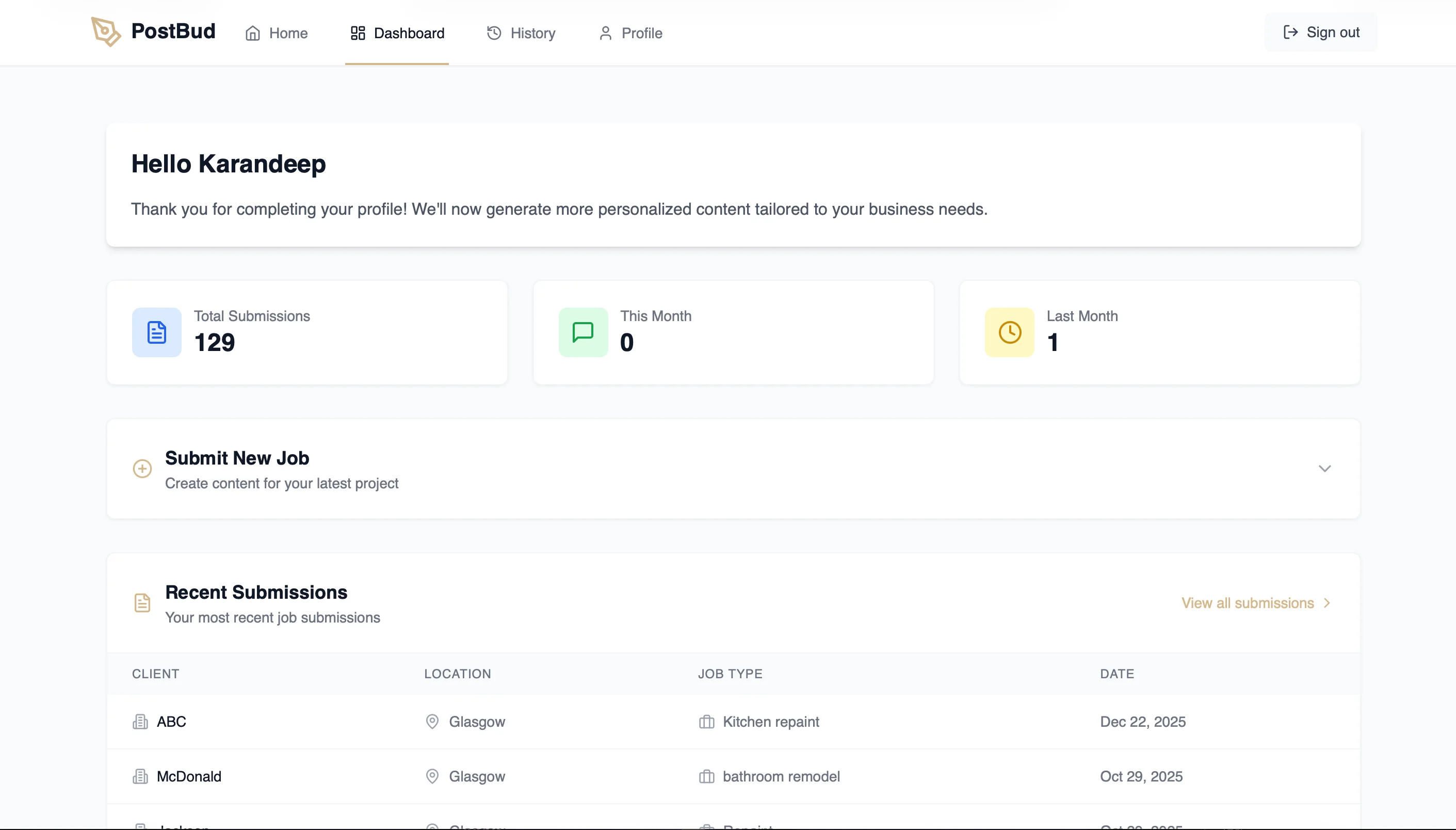
Real businesses, real results. Explore how companies implemented these concepts:
Key Takeaways
Quick wins and actionable insights from this guide:
- Nurture sequences triggered by behavior convert 5-15% of entrants—newsletters rarely drive booked calls
- Build sequences for inquiry nurture, quote follow-up, post-service re-engagement, and lapsed lead reactivation
- Keep emails short (3-5 sentences), one CTA, specific subject lines—not marketing brochure copy
- Exit conditions are critical: stop sequences when contact books, replies, or unsubscribes
- Sequence ROI exceeds $100,000/year for active businesses vs negligible newsletter returns
- Launch inquiry nurture first in 2 weeks, then expand to quote follow-up and re-engagement
AI 101 Services Team
Business Automation Specialists
AI 101 Services helps service businesses implement AI automation solutions that deliver measurable ROI. With 21+ solutions delivered and 15+ clients served, we specialize in turning manual chaos into streamlined digital workflows.